
A North County teacher finishing lesson plans at 9 p.m., an ER nurse checking listings after a 12-hour shift, and a firefighter reviewing numbers at the kitchen table usually hit the same point fast. The home looks doable online. The monthly payment and cash to close say otherwise.
That reaction is common in San Diego, especially for first-time buyers who serve this county and do not have hours to waste on bad fits.
I tell buyers this all the time. Sticker shock does not mean you should stop. It means you need a tighter plan.
For San Diego's heroes, the path is different from the generic advice you see online. Veterans may have VA financing available. Teachers, healthcare workers, first responders, and other public servants may qualify for profession-based benefits, lender credits, or buyer reward programs that can reduce upfront costs or put money back in your pocket after closing. Those options do not fix every affordability problem, but they can improve your position if you set the file up correctly from the start.
The buyers who get traction here usually do three things early. They get clear on payment, not just price. They match their financing to the property types that fit their budget. They use programs built for heroes instead of assuming every loan option works the same.
If you want a practical overview of the process before you start touring homes, review these first-home buying steps.
San Diego is competitive, and the math can be uncomfortable. It is still possible to buy your first home here with the right structure, realistic expectations, and a serious look at the assistance available to the people who serve this community.
Your San Diego Homebuying Dream Is Within Reach
A teacher in North County, a nurse near Mission Valley, and a Marine veteran relocating with family may have very different schedules, but they usually tell me the same thing first. “I thought I'd have more time before I had to figure this out.” Then they see what even modest homes cost and start wondering if buying in San Diego makes sense at all.
That reaction is normal. It doesn't mean homeownership is off the table.
What usually helps is replacing broad fear with a clear plan. A first time buyer in San Diego doesn't need vague motivation. You need to know what price range is workable, which areas deserve your attention, what assistance programs fit your income and profession, and how to avoid wasting time on homes that won't match financing rules.
Practical rule: Don't start with open houses. Start with numbers, eligibility, and a neighborhood short list.
For San Diego's heroes, that structure matters even more. Veterans, first responders, teachers, healthcare workers, and other service-minded buyers often have stable income and strong long-term goals, but they're also short on time. Shift work, deployments, overtime, school schedules, and family obligations make it easy to lose momentum if the process feels confusing.
That's why the smartest approach is a step-by-step one. If you want a practical overview of the sequence, these first-home buying steps are a useful starting point. The buyers who move forward successfully usually aren't the ones who know everything upfront. They're the ones who get organized early, ask sharper questions, and make decisions based on the local San Diego market instead of national advice that doesn't fit this county.
Securing Your Finances and Getting Pre-Approved
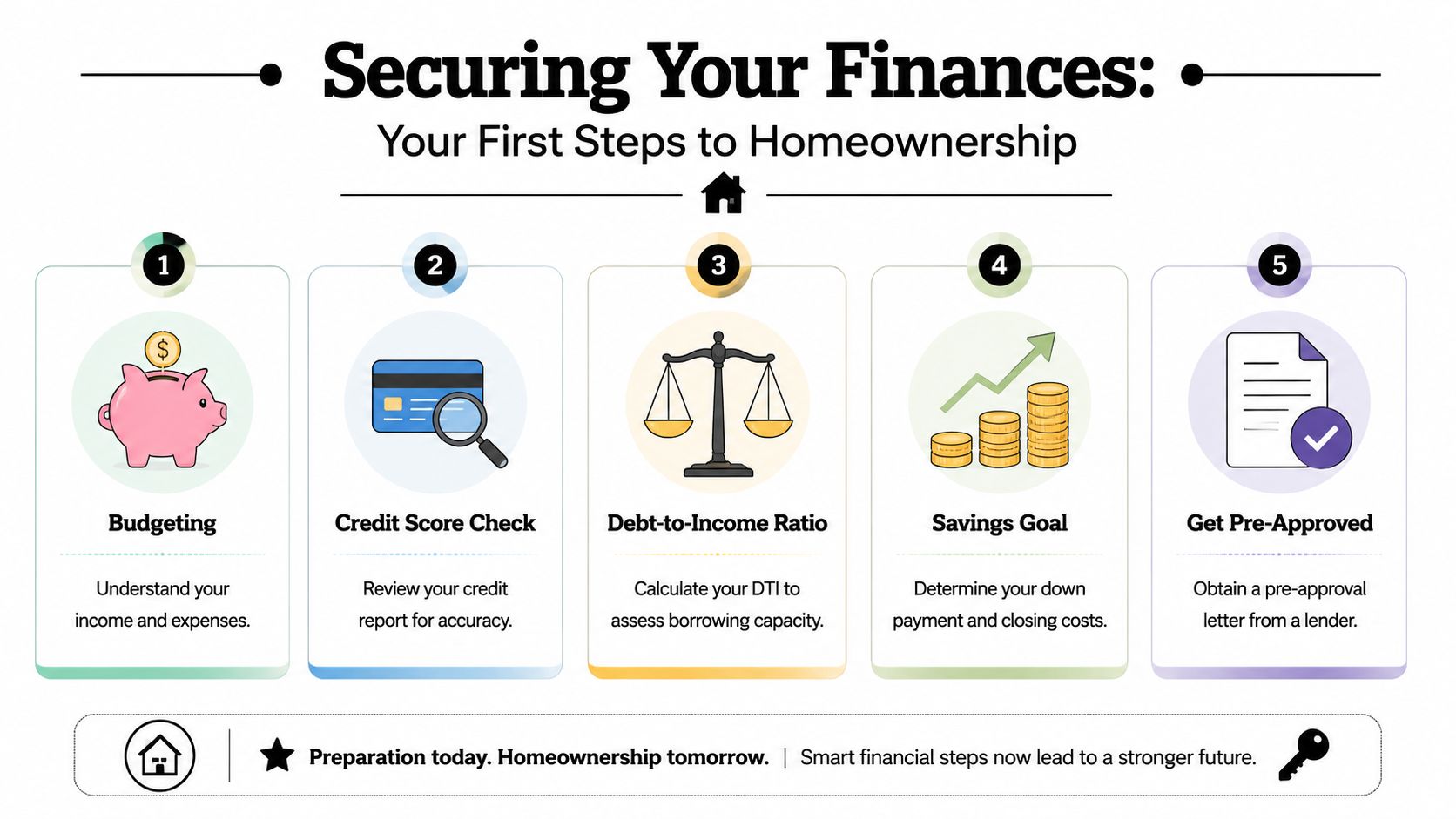
The first financial mistake I see is buyers focusing only on the base mortgage payment. In San Diego, that's not enough. You have to underwrite your own life before a lender underwrites the file.
Expert market guidance for San Diego shows the county's median home list price reached $1,100,000, and a typical single-family home can run $8,900 to $9,500 per month when you include average property tax of 1.15% or about $1,300 per month, homeowner insurance of $200 to $300 per month, and HOA costs of $150 to $350 per month. The same guide notes that first-time buyers make up only 21% of primary residence homebuyers, an all-time low, which tells you how competitive and selective this market has become according to New American Funding's San Diego first-time buyer guide.
Build a real budget, not a hopeful one
If you're buying a condo or townhome, the monthly picture may look different than a detached home, but the lesson is the same. Your payment isn't just principal and interest.
Use this checklist before you ever tour homes:
- Track fixed monthly obligations. Include car payments, student loans, credit cards, childcare, insurance, and recurring subscriptions.
- Estimate ownership costs realistically. In some neighborhoods, HOA dues change the affordability picture fast. In newer communities, Mello-Roos can also affect the payment.
- Leave room for daily life. Commuting, uniforms, kids' activities, and emergency savings still matter after closing.
- Separate down payment from reserves. Don't empty every account just to get the keys.
Buyers get in trouble when they qualify for a payment on paper but haven't stress-tested that payment against their real routine.
Know what pre-approval actually does
A pre-approval isn't a casual online estimate. In a competitive market, it tells sellers your financing has been reviewed with real documentation. That's very different from guessing at a monthly budget based on a mortgage calculator.
A strong pre-approval usually depends on four things:
Income clarity
Lenders want to understand base income and any additional qualifying income. If your pay includes overtime, differentials, or variable components, clean documentation matters.Credit profile
Buyers often assume they need perfect credit. They don't. They do need accurate credit reporting, responsible recent history, and no surprises that surface mid-escrow.Debt-to-income balance
Your monthly obligations affect what's comfortable and what's approvable. For this reason, paying down a specific debt before applying can improve flexibility.Asset documentation
Lenders need to source funds used for down payment, closing costs, and reserves. Large undocumented deposits create delays.
Make your pre-approval stronger
A weak pre-approval letter can hurt more than buyers realize. Before writing offers, ask whether your approval reflects updated paystubs, bank statements, and employment review. Also compare loan structures, not just headline interest rates. This guide on how to compare mortgage rates helps buyers look at the full cost picture.
Here's the no-nonsense version. If the payment only works when everything goes perfectly, it doesn't work. The right pre-approval gives you confidence to shop with purpose, not panic.
Navigating the San Diego Housing Market
You get pre-approved, open the apps, and the first few listings feel discouraging. One condo has the payment you can handle but a high HOA. A house farther east gives you more space but adds an hour of driving on workdays. A place near the hospital, base, station, or school district looks ideal until you see how quickly competition builds.
That is normal in San Diego.
San Diego works like a patchwork of smaller housing markets, not one big one. Commute patterns, school boundaries, property type, and neighborhood rules all shape what a home really costs you each month. For first-time buyers, especially heroes working long shifts or fixed schedules, a wide search usually creates confusion instead of options.

Search by lifestyle, not by map alone
Heroes usually make better buying decisions when they start with daily life. A nurse may need a dependable drive home after a 12-hour shift. A firefighter may care more about freeway access and parking than cosmetic updates. A teacher may want stability near work and their own child's school routine. A veteran may want a property that works now and still has resale or rental appeal later.
Start by ranking neighborhoods against the life you live.
| Priority | What to check |
|---|---|
| Commute | Drive time to base, hospital, school campus, station, or airport during your real work hours |
| Home type | Condo, townhome, or detached home, and whether the upkeep fits your schedule |
| School considerations | Public school boundaries and ratings using GreatSchools.org |
| Monthly overhead | HOA dues, insurance costs, and whether Mello-Roos applies |
| Community fit | Noise, density, parking, walkability, and whether the area feels workable after a long shift |
This part matters more than buyers expect. I have seen first responders stretch for a home they loved online, then realize two weeks later that the commute and HOA setup made the property a poor fit.
Understand the trade-offs by area
North County often draws buyers who want newer neighborhoods, planned communities, or specific school preferences. South Bay can make sense for buyers balancing community ties, access, and relative value. East County often gives buyers more square footage or lot size, but that usually comes with a longer drive. Central neighborhoods offer convenience, but entry-level homes there tend to bring tougher competition and less room in the budget.
None of those options is automatically right.
The right area is the one that supports your work schedule, payment comfort, and long-term plan.
For many hero buyers, the smartest move is to choose two or three target areas instead of chasing every new listing across the county. That tighter search gives your agent and lender room to move quickly when the right property shows up. It also helps you spot patterns in pricing, concessions, and property condition faster. If cash to close is part of the challenge, review these San Diego down payment assistance options for homebuyers before you decide a neighborhood is out of reach.
Avoid two expensive mistakes
First, test the commute in real conditions. Noon traffic will not tell you what a 6 a.m. hospital shift, a school drop-off, or an evening drive back from base feels like.
Second, read the fee and rule structure before you get attached. In newer communities, Mello-Roos can change the monthly picture fast. In condos and townhomes, HOA rules can matter just as much as the dues. Check reserves, special assessments, rental limits, pet restrictions, parking rules, and who handles major maintenance.
Sticker shock is real here. So is buyer fatigue.
A first time buyer San Diego plan works better when it is narrow, disciplined, and honest about trade-offs. Pick a short list of areas. Define your must-haves. Separate cosmetic wants from payment deal-breakers. That is how heroes stay competitive in a market that punishes vague search criteria.
Unlocking Down Payment Assistance and Hero Rewards
A lot of first-time buyers in San Diego can afford a monthly mortgage payment sooner than they can pile up cash for the down payment, closing costs, and reserves. That gap is where the plan usually gets tight. For veterans, teachers, nurses, first responders, and other local heroes, the right assistance mix can turn “almost ready” into “ready to write an offer.”
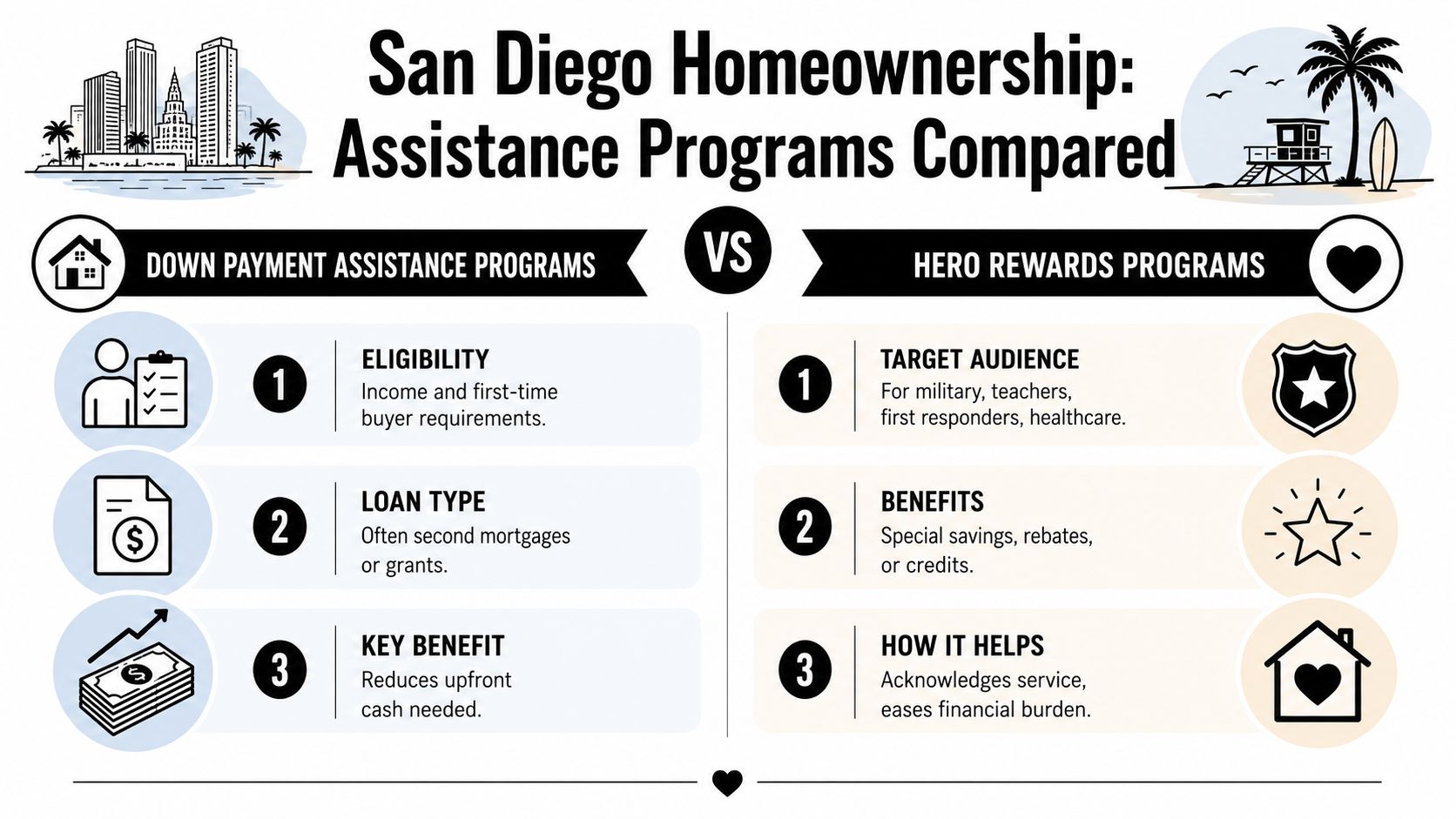
The key is knowing which type of help matches your file. Some programs are built for buyers with lower income. Some help moderate-income households. Hero rewards programs solve a different problem. They can reduce costs for buyers who may not qualify for city or county assistance but still feel squeezed by San Diego prices.
The San Diego Housing Commission is one of the main local resources to review. Its first-time buyer programs include deferred-payment assistance and income-based guidelines, with details posted on SDHC's homebuyer assistance page. Before counting on any program, confirm current purchase limits, area rules, education requirements, and available funding. Those details change, and they matter.
What local assistance looks like
Program names sound similar. The structure behind them is not.
In practice, San Diego buyers may run into deferred-payment second loans, closing cost grants, or a combination of both. Some programs are tied to income caps. Others are limited by location, property type, or household profile. A program that looks generous on paper can still be a poor fit if the home you want is outside the eligible area or the timeline is too tight for the extra documentation.
These are the types of benefits local buyers may see through qualifying SDHC programs:
- Low-income assistance option. Deferred-payment second mortgage help paired with closing cost support for eligible buyers under the applicable income limit.
- Moderate-income assistance option. Larger deferred-payment assistance for down payment and closing costs, subject to current program caps and approval terms.
- Targeted community programs. SDHC has also offered programs aimed at expanding access to homeownership for specific groups and neighborhoods.
- Pilot assistance options. Some limited programs include a mix of grants and deferred loans for households above traditional low-income thresholds.
That is why I tell hero buyers to check eligibility before they shop, not after they find a home. Falling in love with a property first can box you out of the program that would have made the deal work.
Where hero rewards fit
Hero rewards are different from down payment assistance. They are usually profession-based savings tied to military service, education, healthcare, emergency response, law enforcement, public service, or aviation roles. Depending on the lender and program, that can show up as credits, fee savings, or other buyer benefits.
For a San Diego hero, that matters for one simple reason. Plenty of buyers earn too much for income-capped assistance programs and still do not have an easy time bringing in cash to close.
Here is the practical breakdown:
| Option | Best for | Main trade-off |
|---|---|---|
| Down payment assistance | Buyers who need help covering upfront cash to close | Income limits, property rules, extra paperwork, program timelines |
| Hero rewards | Service professionals looking for savings tied to their profession | Benefits vary by lender, transaction structure, and eligibility |
| Combined strategy | Buyers who qualify for both and have time to document it properly | More coordination between lender, agent, and program administrator |
The right question is simple. Which combination helps you close on time without creating extra risk for the offer?
What works and what does not
What works is reviewing assistance early with your lender and running the numbers on the exact homes and price range you are targeting. That includes your earnest money, inspection costs, appraisal, moving expenses, and any gap between the assistance amount and your total cash needed. If you want a clearer picture of how these programs are typically structured, read this guide to San Diego down payment assistance options for homebuyers.
What does not work is assuming every assistance dollar is free money or assuming every listing will fit the rules. Some programs add documents, class requirements, or approval steps that can slow a file if the team is not prepared. In a competitive San Diego market, the buyers who use assistance well are usually the ones who set it up early, keep their paperwork tight, and stay realistic about the homes that fit the program.
Making a Winning Offer and Navigating Escrow
Once financing is lined up and your search area is tight, the process gets more emotional. At this point, buyers either stay disciplined or start chasing homes they were never in a position to win.
In San Diego, a strong offer is more than price. Sellers look at the whole package. They want to know whether your financing is solid, whether your timelines are realistic, and whether the deal is likely to close without avoidable drama.
Build an offer that sellers take seriously
Your agent should help you read the property, the seller's likely priorities, and the recent activity around that home. Some listings need a clean, straightforward offer. Others call for flexibility on timing or terms.
A practical offer usually comes down to these moving parts:
Price strategy
Don't choose a number in a vacuum. Your agent should weigh comparable sales, condition, days on market, and whether the home looks intentionally underpriced to attract attention.Contingencies
Inspection, appraisal, and loan contingencies protect you. Waiving them blindly is not a first-time buyer strategy. Shortening timelines may help, but only if your lender and agent can support that pace.Earnest money and responsiveness
Buyers who return documents quickly and stay organized create confidence. That matters once multiple parties are coordinating deadlines.Seller needs
Sometimes the winning offer isn't the highest one. It's the one that solves the seller's timing problem.
A clean file beats a chaotic high offer more often than buyers expect.
What happens once the offer is accepted
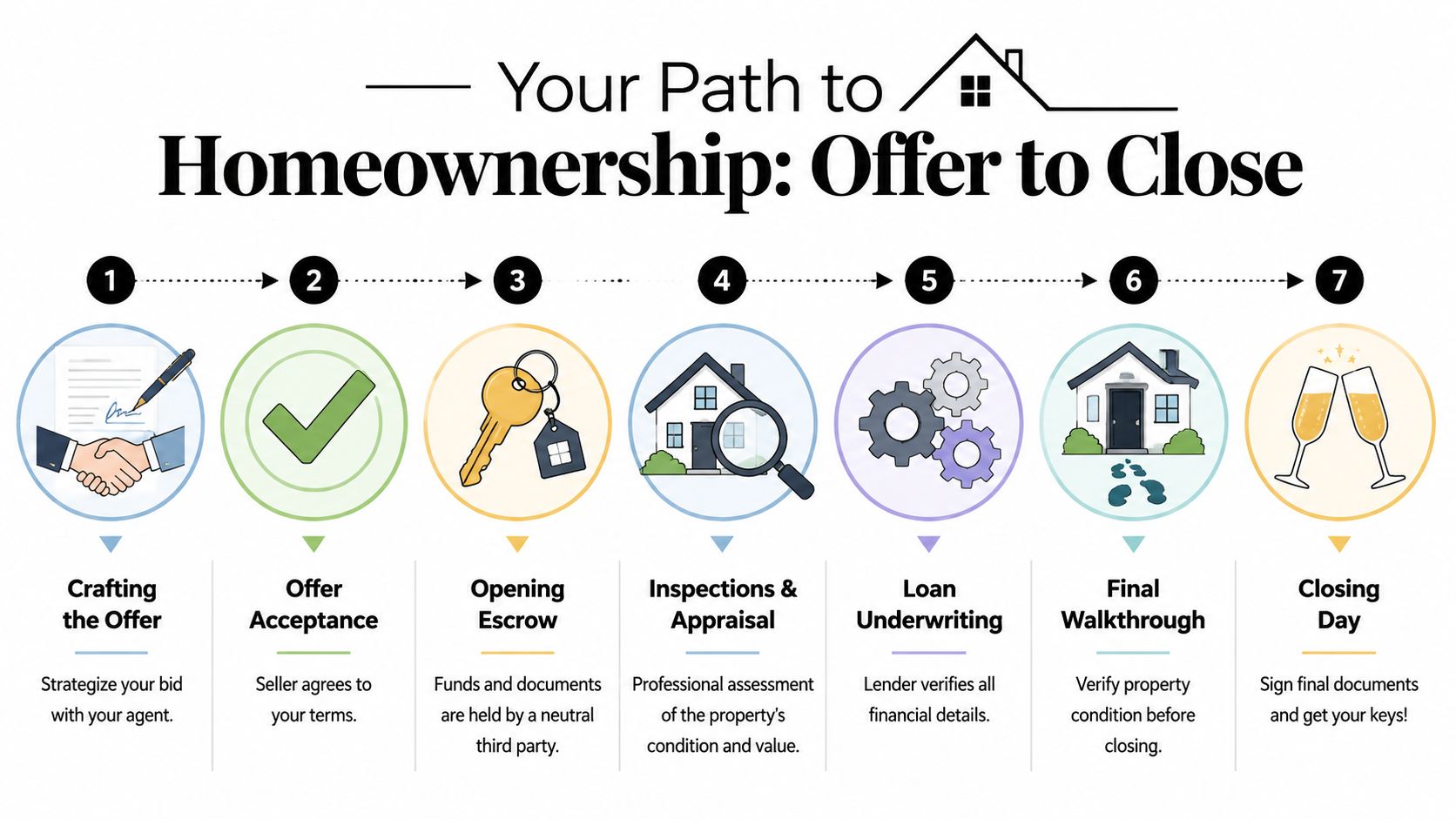
Escrow is the controlled period between acceptance and closing, with a neutral third party handling funds and documents. For first-time buyers, it can feel like constant paperwork. That's normal.
Here's the rhythm most buyers should expect:
- Opening escrow. Initial deposits are made and the transaction calendar starts.
- Inspections. General home inspections are common, and additional specialized inspections may be appropriate depending on the property.
- Appraisal. The lender orders an appraisal to confirm market value for loan purposes.
- Underwriting review. Expect updated document requests. Don't change jobs, open new credit, or move large sums around without discussing it first.
- Final walkthrough. This is your last confirmation that the property's condition matches the agreement.
- Closing. You sign final documents, funds are balanced, and the home records.
The mistakes that cost buyers deals
The biggest unforced errors are simple. Buyers make major purchases during escrow, stop checking email, fail to review disclosures carefully, or assume every issue found in an inspection is a reason to panic.
Read HOA documents if the property has an association. Read seller disclosures slowly. If the home is in a newer community, confirm whether Mello-Roos applies. If school access matters, verify district information independently. This part of the process rewards calm, not speed for its own sake.
Closing the Deal and Your First Year of Homeownership
The keys hit your hand, you walk through the front door, and for about ten minutes it feels unreal. Then the ownership questions start. Which bill is due first. What needs attention now. How much cash should stay in savings instead of going toward furniture and upgrades.
That first year sets the tone.
For San Diego first-time buyers, especially veterans, teachers, nurses, first responders, and other local heroes, the smartest move after closing is simple. Protect your cash and get organized fast. I've seen buyers handle the purchase well, then feel squeezed by the small costs that show up right away. Utility deposits, HOA logistics, a water heater service call, rekeying locks, garage remotes, pest treatment, and property tax notices can all arrive sooner than expected.
Start with the basics and do them in the first week, not “when things settle down.”
What to handle right away
- Keep a real home reserve. Even if the transaction drained more cash than you hoped, hold onto what you can. The first repair usually shows up before the first year is over.
- Store every closing document in one place. Keep your note, deed, title paperwork, insurance policy, closing disclosure, and HOA documents both digitally and in hard copy.
- Confirm how your monthly housing payment is structured. Know whether taxes and insurance are included in your mortgage payment or paid separately.
- Set up utilities and auto-pay carefully. Make payments easy, but review the first few bills line by line so there are no surprises.
- Rekey or replace exterior locks. It is a low-cost safety step many buyers postpone.
- Build a maintenance calendar. Schedule HVAC service, change filters, test smoke and carbon monoxide detectors, and make a list of inspection items to address over time.
- Meet the neighbors. Good neighbors can save you time on everything from trash pickup questions to reliable contractor recommendations.
The other big first-year rule is to avoid creating fresh financial stress. Do not run up credit cards for renovations unless the payment fits your budget comfortably. Do not assume your mortgage payment is the full cost of ownership either. Condos and townhomes may bring HOA increases. Older homes can need plumbing, electrical, or roof work sooner than expected. Newer homes often come with less immediate repair risk, but buyers may face higher taxes, Mello-Roos, or stricter community rules.
There is always a trade-off.
Heroes who used a specialized program to get into the market should treat that advantage with care after closing. The goal was not just to buy the home. The goal was to stay financially solid in it. That means tracking your payment due date, understanding your escrow account, reviewing annual insurance changes, and asking questions early if something on your statement does not make sense.
San Diego is expensive. That part is real. But I've watched many first-time buyers succeed here because they stayed disciplined after closing, kept reserves, and handled small issues before they turned into expensive ones.
If you're ready to map out a realistic path to buying in San Diego, talk with California Loans for Heroes. Their team helps veterans, active-duty military, first responders, law enforcement officers, firefighters, nurses, healthcare professionals, teachers, pilots, and public service employees understand financing options, explore assistance opportunities, and move forward with one-on-one guidance built for California heroes.