
You're staring at the same California housing problem a lot of educators face right now. Your paycheck can support a mortgage, but the down payment keeps turning the dream into a waiting game, especially when rents are high and savings get drained month after month. The good news is that teacher grants for home buying are no longer just a vague idea. There are federal, state, local, and lender-side programs that can shrink the upfront cash gap if you know which ones fit a California educator's situation.
The key is to ignore generic advice and move straight to the programs that matter in California. Some are true grants, some are deferred loans, some reduce the purchase price, and some come back as closing-cost credits or rebates after closing. A few work especially well in expensive markets like San Francisco and Silicon Valley, while others are built for statewide use through approved lenders. If you're teaching in California and trying to buy your first home or a move-up home, the right mix can change everything.
1. Housing Grants for Teachers Your 2026 California Guide
California educators need a practical roadmap, not another broad homebuying article that treats every buyer the same. The Housing Grants for Teachers guide from California Loans for Heroes is built for that exact problem, and it pairs well with the site's down payment assistance resources for teachers. It focuses on the programs that show up in California transactions, then explains how to combine them with down-payment help and lender support without wasting time on options that won't fit your county, income, or school district.

Why this belongs at the top of the list
A good educator homebuying guide should save time first and money second. This one does that by narrowing the field to California-specific opportunities and by emphasizing how to move quickly when funds open up or when local assistance is limited. That matters because many teacher programs are competitive, county-specific, or tied to a lender network, so the wrong starting point can cost you an opening.
The strongest part of a lender-supported guide is the practical sequencing. You want to know which documents to gather, when to get pre-approved, and which assistance layers can be used together so you don't accidentally disqualify yourself. A teacher who understands the order of operations can often make a cleaner offer than a buyer who only learns about assistance after shopping for homes.
Practical rule: Use a California-focused guide to build your short list, then verify every program directly with the lender or agency before you write an offer.
What works and what does not
What works is a guide that separates real grant money from deferred loans, tax credits, and post-closing rebates. What does not work is assuming every “teacher program” is a grant in the strict sense. In practice, the best California buyers use the guide as a filter, then pair it with one-on-one mortgage support so they can compare grant, loan, and rebate structures side by side.
2. HUD Good Neighbor Next Door
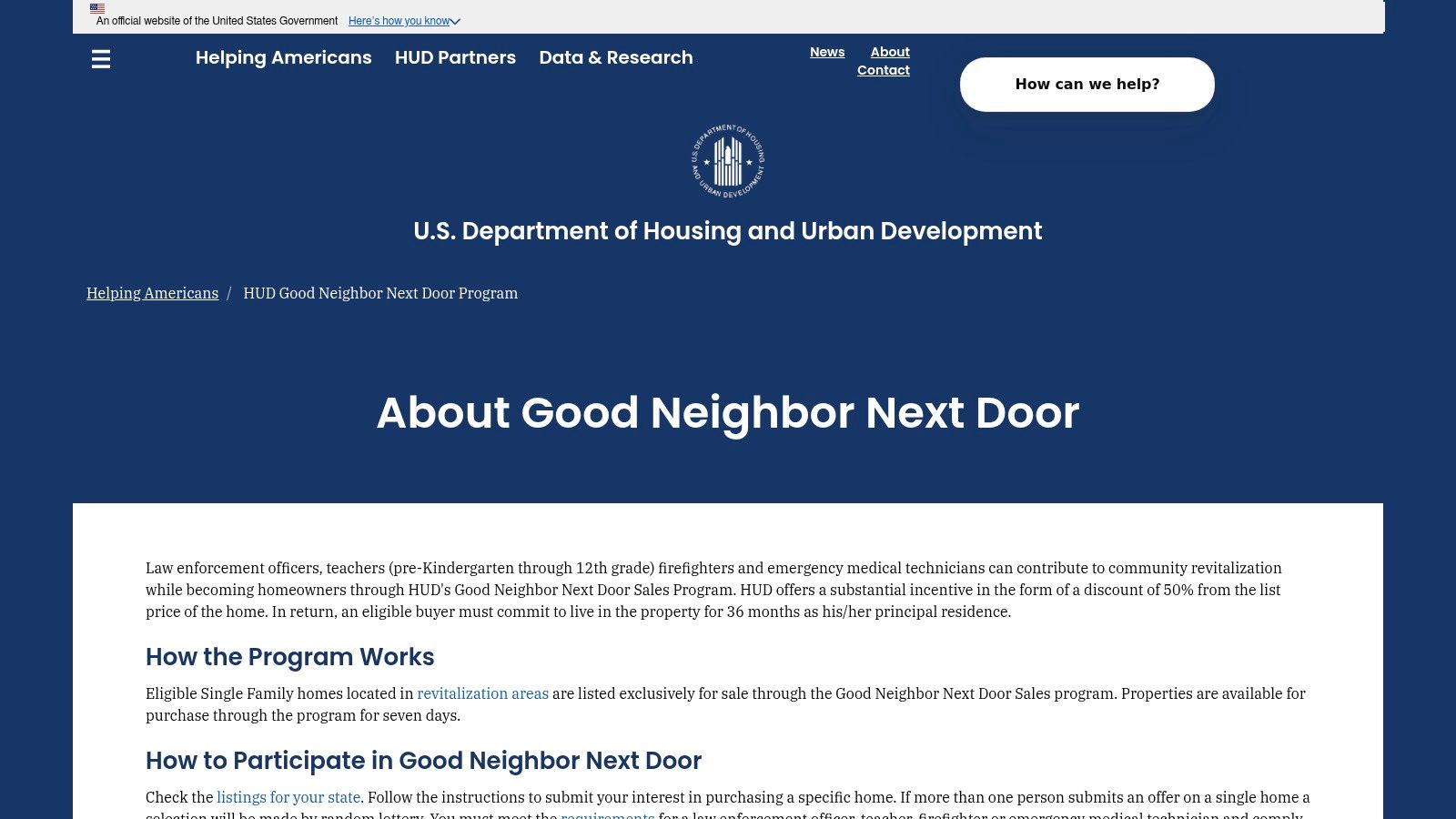
A California teacher who can work within a tight property search may find real value in HUD's Good Neighbor Next Door program. For eligible buyers, the program offers a 50% discount off the home's list price on select HUD homes, and the buyer must live in the property for at least 36 months. HUD Good Neighbor Next Door (GNND) That is not a traditional grant, but in practice it can function like one because the purchase price drops before financing starts.
Where GNND helps
GNND works best for teachers who can be flexible on neighborhood and timing. The inventory is limited, and you have to buy from the homes HUD has placed into the program. If you find a qualifying property in a California market where prices are tight, the discount can create an opening that would not exist otherwise.
The trade-off is compliance. You are not just buying a house, you are accepting a property-use commitment that the program monitors. That makes GNND a better fit for educators who know they will stay put and want the biggest front-end price break rather than the widest choice of homes.
How to use it in California
For California teachers, GNND is rarely the only tool. It is more realistic to treat it as a high-value lottery ticket that may or may not match your target city. If it does, the payoff can be exceptional. If it does not, you move on to statewide assistance and local educator programs without losing momentum.
3. Teacher Next Door
Teacher Next Door is useful because it acts like a concierge, not a single grant source. The platform connects educators to down-payment and closing-cost help, and the company says its educator package can include up to $8,000 in non-repayable grants and up to $15,000 in down-payment aid through a 3% second-lien loan. Its main Teacher Next Door website is where teachers can start that matching process.

Why California buyers use it
California buyers benefit from the fact that Teacher Next Door can surface options across markets instead of forcing you to know every local program in advance. That's valuable in a state where city, county, and lender participation can change the deal. It's also one of the easier ways to check whether a national program or local incentive can be layered with a California first mortgage.
The catch is that benefits vary by location and partner participation. If you want the full value, you usually need to work with the participating professionals in the network. That's fine if you want coordination. It's less helpful if you prefer total control over every vendor choice.
Teacher-focused platforms work best when you treat them as a starting point, not the final approval letter.
Best use case
In practice, Teacher Next Door is strongest for educators who want a single doorway into multiple assistance options. It's especially helpful if you're unsure whether your best path is a grant, lender credit, local assistance, or a combination. For California teachers who are price-sensitive but also short on time, that speed can matter as much as the dollars.
4. Golden State Finance Authority Platinum and Platinum Select
For statewide California coverage, GSFA belongs near the top of the stack. The Platinum programs from the Golden State Finance Authority provide down-payment and closing-cost assistance at roughly 5% to 5.5% of the loan amount, and a portion may be a gift while some aid can be forgivable depending on the loan type and promotion. Because it's a California-focused public program, it fits the way many educators buy, through participating lenders rather than a one-off city office.

Why it stands out
GSFA works with FHA, VA, USDA, and conventional first mortgages, so it doesn't force every buyer into the same loan path. That flexibility makes it useful for teachers who already know their budget but still need help with upfront cash. In a market like California, where many buyers can afford the payment but not the initial check, that structure is often the difference between moving forward and pausing for another year.
The downside is that income, credit, and debt-to-income limits apply, and the assistance structure can change. Funding and special promotions may also be limited, so the program rewards buyers who are organized and ready to move. If you wait until the perfect home is under contract to figure out the program, you may be too late.
How to think about stacking
GSFA is especially attractive when paired with other assistance that doesn't conflict with its terms. A teacher who qualifies can often use it as the statewide backbone, then look for local city or employer aid to close the gap. That's where California buyers tend to get the best results, not from one giant source of money, but from smart layering.
5. CalHFA Dream For All Shared Appreciation Loan
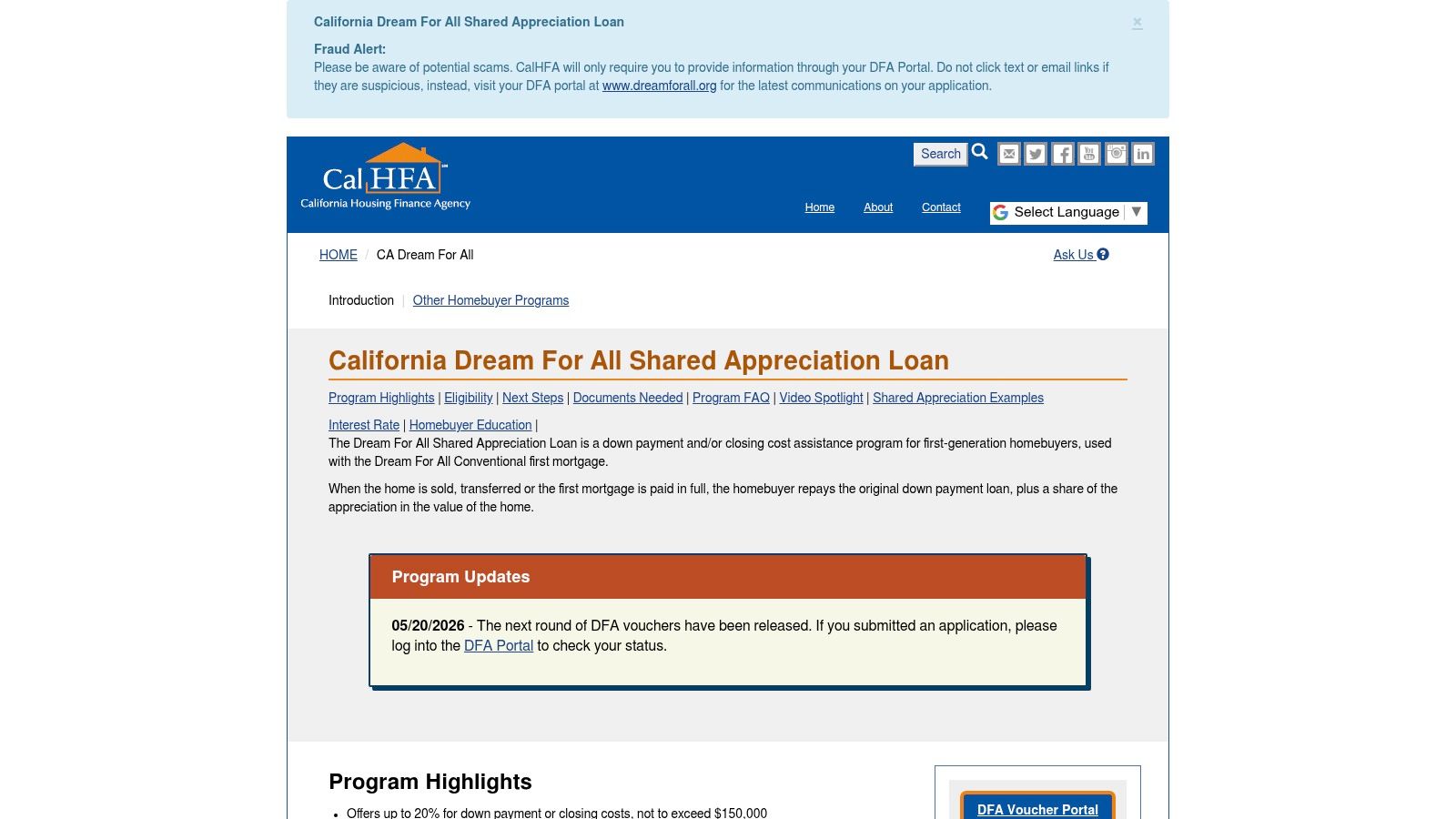
CalHFA's Dream For All program is one of the strongest California options for eligible first-time and first-generation buyers because it can provide up to 20% of the purchase price as a silent second with no monthly payment, and recent rounds have been capped at $150,000. The trade-off is shared appreciation, which means CalHFA takes part in future value if you sell or refinance. For teachers who are otherwise priced out by the down payment, that exchange can still make sense.
When this makes sense
Dream For All makes sense when the purchase price is high enough that a large assistance amount changes the loan calculation in a real way. It can lower the mortgage amount, and in some cases it helps a buyer avoid a smaller down payment that would otherwise lead to higher monthly costs. That is why it has become such a headline program for California educators who meet the eligibility rules and can move quickly during an open funding round.
The challenge is competition. Buyers do not just apply and wait. Funding rounds are limited, and many borrowers need to be ready before the window opens. Teachers who want a real shot at this program need both a lender and a plan, because timing affects qualification in practice.
A shared appreciation caution
A shared-appreciation loan solves today's affordability problem by giving up some future upside. That can be a smart trade in a market where saving cash is the bigger obstacle, but it should be a deliberate choice, not a surprise that shows up during escrow.
For educators who want to compare that structure with other assistance options, California Loans for Heroes has a plain-English overview of how shared appreciation mortgages work. It is a useful check before deciding whether Dream For All fits your long-term plans.
6. CalHFA MyHome Assistance Program
The CalHFA MyHome Assistance Program is one of the cleanest statewide tools for teachers who want a deferred-payment junior loan for down payment and closing costs. It pairs with eligible CalHFA first mortgages, requires homebuyer education, and the assistance becomes due when the home is sold, refinanced, or paid off. For many educators, that structure is easier to understand than a more complex shared-equity product.
Why educators like it
MyHome is predictable. There's no monthly payment on the assistance portion, so it helps preserve cash flow after closing. That matters for teachers who want to keep emergency savings intact instead of using every dollar to force a down payment.
It also works as a practical bridge when a teacher's savings are close but not quite enough. The program doesn't solve every affordability issue, and it does come with income and purchase price caps, but it often fits buyers who want a state-backed structure without jumping into a more aggressive equity-sharing model.
Best way to use MyHome
MyHome works best with pre-planning. Get your CalHFA-approved lender involved early, complete the required education, and map the program against any local assistance you may also qualify for. That sequence keeps you from scrambling during escrow and gives you a realistic picture of what your total cash need will be.
7. San Francisco Educators Downpayment Assistance Loan Program
For teachers employed by SFUSD or City College of San Francisco, the San Francisco Educators Downpayment Assistance Loan Program is one of the most targeted local tools in the state. It has historically offered shared-appreciation assistance of up to $500,000 toward market-rate home purchases in the city, which is unusually large for an educator-specific program. That scale reflects the reality of San Francisco housing, where generic assistance often isn't enough to move the needle.
Why this is different
This is not a broad statewide benefit. It's a city strategy meant to keep educators living where they work. The program requires local employment verification, first-time buyer education, and application windows managed by the Mayor's Office of Housing and Community Development. That makes it highly specific, but also highly valuable for the teachers who fit the criteria.
Because the program is tied to San Francisco and uses shared appreciation, it's best for buyers who plan to stay in the city and want to preserve monthly affordability. If you're likely to move quickly, or if you want to maximize future equity without a repayment share, this may not be the right fit.
What to watch for
Competition is the issue here. Local educator programs in high-cost markets can be among the best options available, but they're usually limited in annual slots and funding. If you qualify, the process needs to start early, with full documentation ready before a window opens.
8. Housing Trust Silicon Valley Homebuyer Empowerment Loan Program
The Housing Trust Silicon Valley Homebuyer Empowerment Loan Program is a strong regional option for Bay Area teachers who need a large assistance layer but don't fit the strictest statewide definitions. It offers up to 10% of the purchase price as shared-appreciation assistance, and it can help a buyer reach a stronger down payment position without monthly payments on the assistance portion. In high-cost counties, that can be the difference between a marginal offer and a viable one.
Who it helps most
This program tends to work well for teachers in Santa Clara and nearby counties whose incomes are too high for some narrower programs but still not enough to comfortably buy without help. It's also useful when you're trying to combine buyer funds with assistance to get closer to a full down payment and potentially reduce mortgage insurance exposure.
The trade-off is the shared appreciation obligation and the geographic limits. You need to be in the right part of the Bay Area, and you need to be comfortable with the fact that some future value will be shared when the loan is settled. For many educators, that's still a fair exchange for getting into the market sooner.
Why it belongs in a California stack
Housing Trust Silicon Valley is not a replacement for statewide aid. It's a regional layer that can sit on top of a broader plan. If you're a Bay Area teacher comparing city, state, and employer options, this is one of the local programs worth putting on the short list early.
9. SchoolsFirst Federal Credit Union School Employee Mortgage
The SchoolsFirst Federal Credit Union School Employee Mortgage is not a grant, but it can still play a useful role in a California teacher homebuying plan, especially when it sits alongside outside assistance. SchoolsFirst offers mortgage options designed for school employees, including reduced-down-payment products and select fixed-rate loans without PMI. For teachers, that can make both approval and the monthly payment structure easier to work with.
Why lender fit matters
Mortgage approval is not only about rate. It also depends on whether the lender understands school-district pay schedules, benefit structures, and the way educator income often arrives across the year. SchoolsFirst is built around that environment, which can reduce friction for borrowers whose pay does not look like a standard corporate paycheck.
This is still a loan product, not free assistance. If you need cash to close, you still need a California support program alongside it. The value here is lender familiarity, member-oriented loan options, and potential savings on the mortgage itself.
Best pairing strategy
California Loans for Heroes fits naturally here, because a school-employee mortgage usually works better when it is set inside a broader assistance plan. The home loan programs for teachers page gives educators a practical way to compare mortgage structures with down-payment help and see which combination is realistic for their budget. That kind of comparison helps keep a solid assistance program from being matched with the wrong loan.
10. Homes for Heroes Teacher Savings Program
The Homes for Heroes teacher savings program is different from the grant-style options above because it uses a post-closing rebate structure called Hero Rewards rather than a lender grant. The company says the average savings is $3,000 when a buyer or seller uses its local real estate and mortgage specialists, and $6,000 if the customer both buys and sells through the program (Homes for Heroes teacher savings program). It's a useful reminder that “teacher grants” in the broader market sometimes really mean closing credits or rebates.
How it fits a California plan
For California educators, Homes for Heroes works best as a closing-cost offset, not the primary source of down payment money. Because it can be stacked with eligible DPA programs where permitted, it can still improve your total economics without changing the structure of your first mortgage. That makes it valuable in a layered strategy, especially when every dollar matters.
The company also serves other public-service groups, including firefighters, EMS, law enforcement, active military, veterans, and healthcare workers. That broader network can be useful if your household includes more than one HERO profession and you want to compare the support available across occupations.
What to expect
The key distinction is simple. This is a savings program, not a government grant. If you want a one-stop source of potential closing savings, it deserves a look. If you want direct assistance for the down payment itself, it should sit alongside state or local aid rather than replace it.
Teacher Home-Buying Grants: 10-Program Comparison
| Program / Service | Type & Target Audience | Core Benefit / Assistance | Main Limitations | Stacking & Value to HEROs |
|---|---|---|---|---|
| Housing Grants for Teachers: Your 2026 California Guide | Informational guide for California educators | Curated list of CA programs, eligibility rules, application tips, access to HERO Home Loan & Buyer Rewards | Not a funding source; program availability varies by county; lender-hosted content | Shows how to combine grants with DPA and connect to one-on-one HERO mortgage support |
| HUD Good Neighbor Next Door (GNND) | Federal discount program for K–12 teachers & other public servants | 50% off HUD list price; FHA pairing possible (low cash to close); $100 down options | Very limited, location-specific inventory; 36-month occupancy & resale rules | Often paired with FHA financing; can be stacked carefully with other DPA where allowed |
| Teacher Next Door (TND) | National concierge/marketplace for educators | Matches teachers to local DPA/grants, negotiates lender credits, connects agents/lenders | Benefits vary by partner/location; some “grants” are credits; must use partners | Helps identify stackable programs and connect to lenders/agents (may complement HERO offerings) |
| GSFA Platinum / Platinum Select | State DPA via public agency; statewide | ~5%–5.5% down/closing-cost assistance; portion may be gift or forgivable; works with FHA/VA/USDA/Conventional | Income/FICO/DTI caps; funding/promotions and lender participation can vary | Available through participating lenders statewide; can often layer with local assistance |
| CalHFA Dream For All (DFA) – Shared Appreciation | CalHFA shared-appreciation silent second for first-time/first-gen buyers | Up to 20% (capped, e.g., rounds to ~$150k), no monthly payment; repaid via share of appreciation | Competitive lottery/voucher rounds; reduces future net proceeds on sale/refi | Must pair with CalHFA first mortgage; large assistance can be combined with other DPA strategies |
| CalHFA MyHome Assistance Program | Deferred-payment junior loan for CalHFA borrowers | Down payment/closing-cost junior lien, no monthly payment until sale/refi/payoff | Must use CalHFA first mortgage; income and purchase-price caps; homebuyer ed required | Standard CalHFA stack; commonly used by educators to bridge upfront costs |
| San Francisco Educators Downpayment Assistance Loan (DALP) | City-run shared-appreciation program for SFUSD/City College educators | Very high-dollar deferred/shared-appreciation loans (historically up to ~$500k) | Extremely competitive, limited slots; purchase must be in San Francisco; shared appreciation owed later | Targeted to keep teachers in SF; pairs with first mortgage and local admin processes |
| Housing Trust Silicon Valley – HELP | Regional shared-appreciation DPA for Bay Area buyers | Up to 10% shared-appreciation assistance; targets middle-income workforce including teachers | Geographic and income limits; cyclical funding; shared appreciation on sale/refi | Helps reach 20% down when combined with buyer funds and other DPA; useful in high-cost counties |
| SchoolsFirst Federal Credit Union – School Employee Mortgage | Credit union mortgage programs for educators | Educator-focused loans, low-down-payment options, some no-PMI products, underwriting that understands pay schedules | Membership required; not a grant; rebates/credits vary by program | Can be used with DPA programs; familiar underwriting may ease approval for teachers |
| Homes for Heroes – Teacher Savings Program | National rebate network for heroes including teachers | Cash-back style rebates/credits at or after closing (avg. reported ~$3,000) via local affiliates | Savings depend on local affiliate participation and home price; not government funding | Can stack with DPA where allowed; provides direct closing-cost savings complementary to HERO services |
Your Next Step to Homeownership with California Loans for Heroes
Teacher homebuying assistance in California works best when you stop treating every program as if it solves the same problem. Some options reduce the purchase price, some cover down payment and closing costs, some defer repayment, and some give you cash-like savings at closing. The strongest buyers use that mix strategically, especially in expensive markets where the monthly payment may be doable but the upfront cash still feels out of reach.
For California educators, the path usually starts with eligibility, not with home shopping. You want to know whether you fit a statewide program like CalHFA or GSFA, whether a city or regional tool like San Francisco Educators-DALP or Housing Trust Silicon Valley makes sense, and whether a national option like GNND, Teacher Next Door, or Homes for Heroes can be layered on top. If you're a school employee, lender fit matters too, because the wrong mortgage structure can make even a strong assistance package feel harder to use.
That's where a coordinated plan matters. The best results usually come from pairing a grant or DPA program with a mortgage team that understands educator income, school calendars, and California underwriting realities. If you're trying to buy in 2026, you don't need more noise. You need a clear sequence, the right documentation, and a lender who can help you compare programs without guessing.
California Loans for Heroes helps teachers compare California down payment assistance, educator mortgage options, and HERO Home Loan benefits in one place. If you want a clearer path to buying in California, visit California Loans for Heroes and ask for help building a teacher-focused homebuying plan that fits your budget and your city.