
A rate-and-term refinance is a straightforward way to replace your current mortgage with a new one that has a better interest rate or a more favorable term, without cashing out any home equity. In plain terms, the new loan pays off the old one, and your loan balance generally stays tied to what you already owe, plus allowable closing costs and prepaids.
If you're a California teacher, nurse, firefighter, police officer, or other public service professional, this question usually comes up at a very practical moment. Your mortgage payment feels heavier than it should, rates may have changed since you bought, and you're trying to decide whether refinancing would improve your monthly budget or just create more paperwork.
That's where many homeowners get stuck. They hear “refinance” and immediately wonder whether it means taking cash out, extending debt, restarting the loan clock, or paying thousands upfront for very little benefit. Those are fair concerns.
A rate-and-term refinance is often the cleanest refinance option because its purpose is simple. You're trying to improve the terms of the loan you already have, not turn your home equity into cash. For California homeowners, that distinction matters even more because loan limits, property values, insurance costs, and monthly budgets can all feel tighter here than in many other states.
Is a Rate and Term Refinance Right for You
You may already know the feeling. You lock in a mortgage during a tough rate period, a few years pass, and the payment still feels heavier than it should. In California, where housing costs, insurance, and everyday expenses all compete for room in the same household budget, even a modest payment change can matter.
For a teacher, police officer, firefighter, nurse, or other public servant, that question is usually practical, not theoretical. Can this loan be adjusted to fit real life better without turning home equity into spending money?
A rate-and-term refinance can be a good fit when the goal is simple. You want to improve the loan you already have by lowering the rate, changing the repayment timeline, or both. It works a lot like replacing an old car loan with one that better matches your current budget and priorities. The car stays the same. The financing changes.
Signs this option may fit your situation
This type of refinance often makes sense if you want to:
- Reduce the monthly payment: A lower rate can free up money for savings, childcare, retirement, or other priorities.
- Shorten the payoff period: Some homeowners switch to a shorter term to build equity faster and pay less interest over time.
- Create more predictability: A different term can make the payment schedule feel more manageable and easier to plan around.
- Leave equity in place: You want better loan terms, but you do not want to borrow extra cash against the home.
For California homeowners, that last point matters more than many national articles suggest. High property values can create a lot of equity on paper, but that does not always mean pulling cash out is the right move. If your goal is to improve the mortgage itself, a rate-and-term refinance is often the cleaner option.
If you are still comparing offers, a side by side review of how to compare mortgage rates can help you see past the headline rate and focus on the full cost.
Practical rule: Refinance to solve a specific problem. A lower payment, a faster payoff, or a steadier loan structure are solid reasons.
Questions to ask yourself first
Before you spend time gathering documents, ask yourself:
- Am I trying to lower my payment, pay off the loan faster, or balance both goals?
- How long do I expect to stay in this home?
- Will the monthly savings justify the closing costs?
- Does my current income, credit profile, and home value put me in a strong position to refinance?
California adds a few extra layers to this decision. Home values can help with qualification, but higher balances can also make costs feel larger. Some borrowers in public service may also qualify for specialized programs or fee savings designed for local heroes, which can shift the math in a favorable direction.
The right refinance should make your mortgage easier to live with, not just newer on paper.
The Core Concept of a Rate and Term Refinance
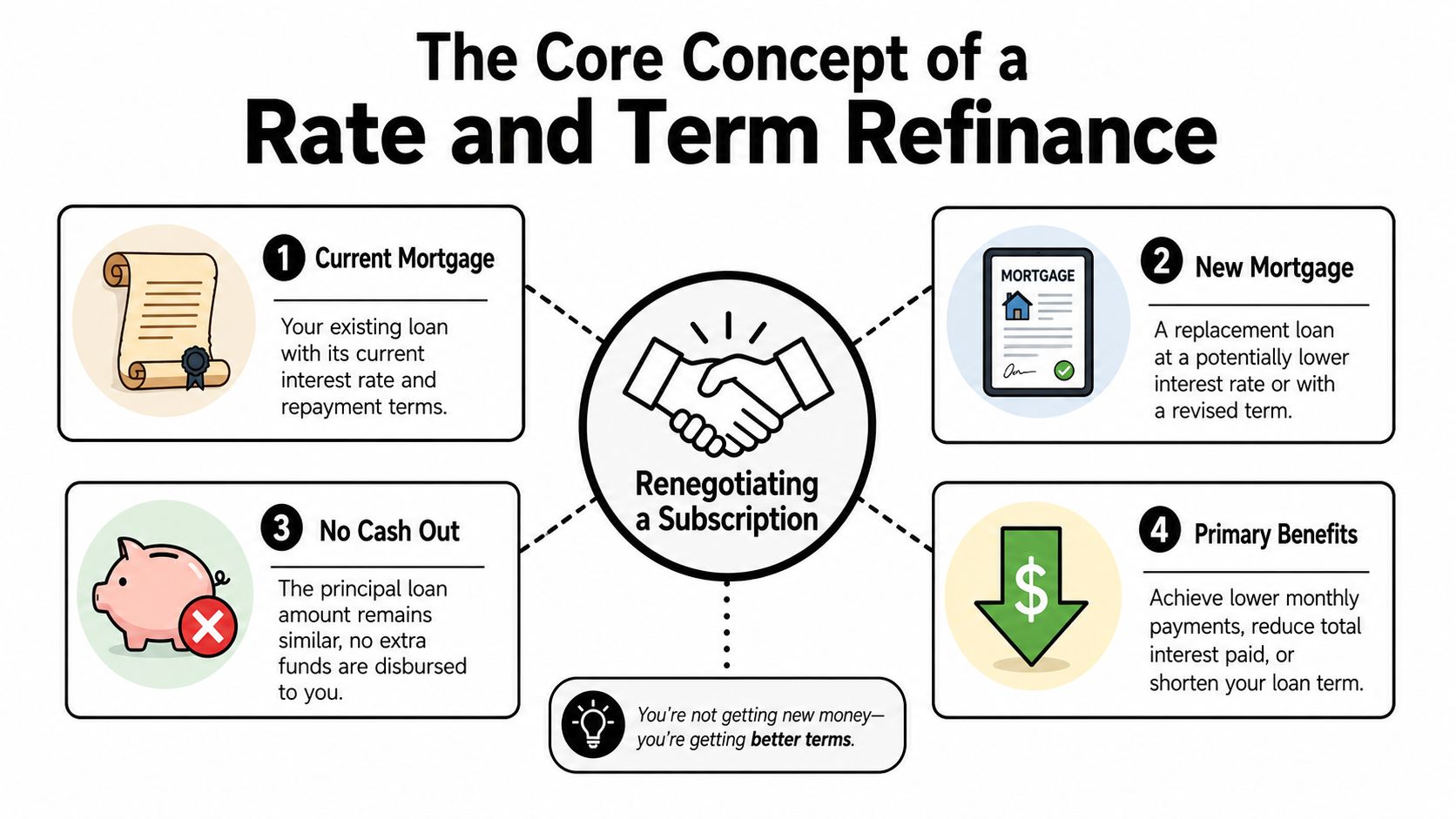
A rate-and-term refinance replaces your current mortgage with a new one that is meant to improve how the loan works for you. The two parts of the name tell you what can change. The rate is the interest rate. The term is the length of time you have to repay the loan.
A simple way to picture it is a loan reset, not a new borrowing event. Your old mortgage gets paid off. A new mortgage takes its place, usually with a lower rate, a different payoff timeline, or both.
Two main goals borrowers usually have
California homeowners usually come to this option with one of two goals in mind, and sometimes both.
Lower the interest rate
A lower rate can reduce the cost of carrying the same mortgage balance. That may mean a smaller monthly payment, less interest paid over time, or both, depending on the new term you choose.
For example, a homeowner who bought during a higher-rate period may now qualify for better pricing because rates improved, their credit strengthened, or their equity position got stronger as California home values rose. If you want to test what that could look like with real numbers, a VA refinance rates calculator for California homeowners can help you estimate payment changes before you apply.
Even a modest rate drop can matter on a large California loan balance.
Change the loan term
The second common goal is changing the repayment timeline. A homeowner might move from a 30-year mortgage to a 20-year or 15-year loan to pay the home off sooner. Others may reset into a fresh 30-year term to ease monthly pressure and create more room in the household budget.
The math involved can feel counterintuitive. A shorter term often raises the monthly payment while lowering total interest over the life of the loan. A longer term may lower the payment but spread repayment over more years. For a teacher, firefighter, nurse, or police officer managing California housing costs, that tradeoff is often less about theory and more about daily cash flow versus long-term debt reduction.
What stays the same and what changes
The purpose of the loan stays tied to your existing mortgage. You are refinancing the debt attached to the home, not turning equity into spending money.
That distinction matters because it keeps the transaction focused. If your goal is to improve the mortgage itself, rate-and-term refinancing is usually the cleaner tool.
| What changes | What usually stays the same |
|---|---|
| Interest rate | The loan remains secured by your home |
| Loan term | The refinance is based on the existing mortgage balance and allowable costs |
| Monthly payment structure | The transaction is designed to avoid giving you cash at closing |
For California borrowers, that clean structure can be especially appealing. High home values often create a temptation to borrow against equity, but many homeowners, especially public-service professionals using specialized hero-focused programs, are better served by improving the mortgage terms first and keeping more equity intact.
A good refinance improves the loan in a way you can actually feel each month, or clearly measure over time.
Rate and Term vs Cash-Out Refinance
Many homeowners often get confused. Both are refinances. Both replace your current mortgage. But they solve very different problems.
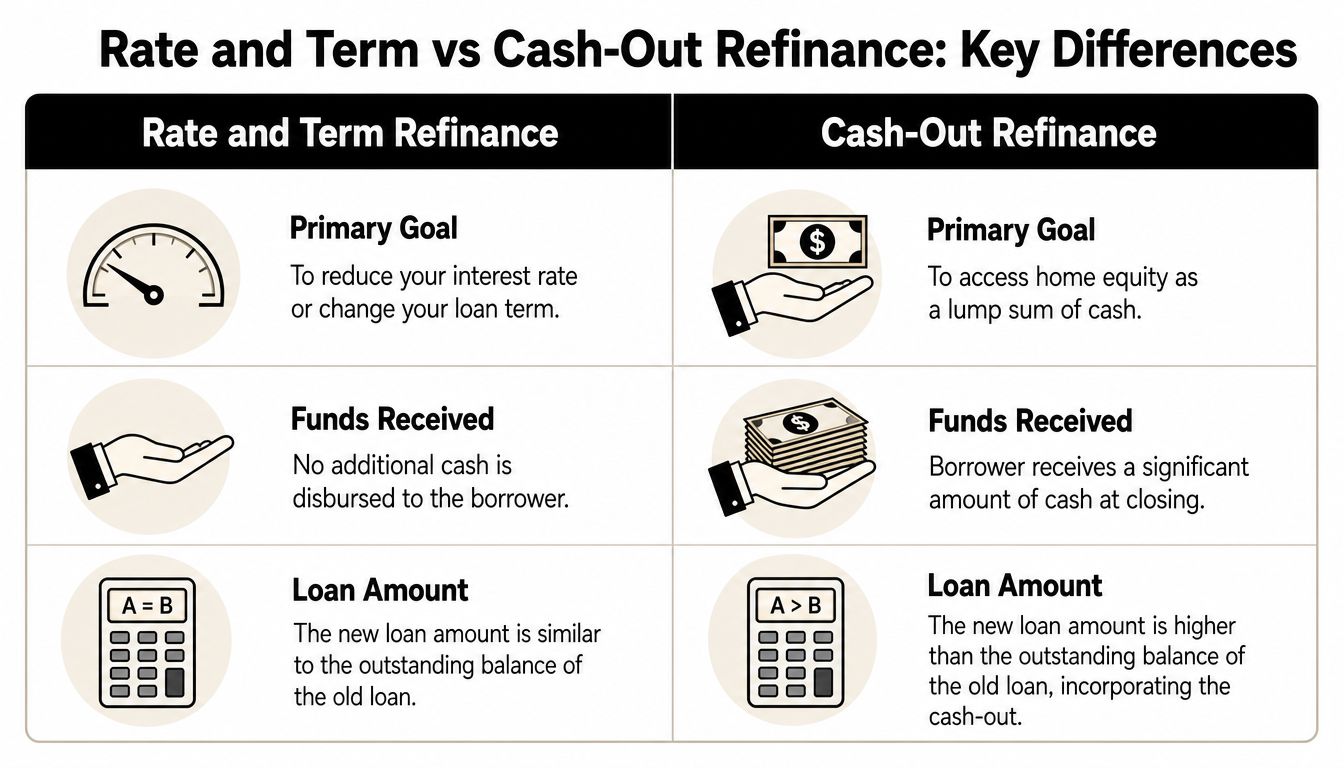
A rate-and-term refinance is about improving the loan you already have. A cash-out refinance is about borrowing against your equity and receiving funds at closing.
Rate-and-Term vs. Cash-Out Refinance at a Glance
| Feature | Rate-and-Term Refinance | Cash-Out Refinance |
|---|---|---|
| Primary purpose | Improve rate, term, or both | Access home equity as cash |
| Cash to borrower | No | Yes |
| New loan amount | Similar to current payoff, plus allowable costs and prepaids | Higher than current payoff because it includes cash taken out |
| Typical mindset | Cost-saving and loan optimization | Liquidity and borrowing strategy |
| Equity impact | Preserves equity position more closely | Uses equity to create cash proceeds |
The legal and practical difference
The cleanest definition comes from The Lenders Network's explanation of rate-and-term refinancing, which says a rate-and-term refinance is technically defined as a "no-cash-out" transaction where the new loan principal matches the existing payoff balance plus allowable closing costs and prepaids, strictly prohibiting the extraction of home equity as cash proceeds.
That's not just technical language. It tells you exactly what the product is built to do.
If you refinance and receive meaningful cash back for a kitchen remodel, debt consolidation, or emergency reserves, that's not a rate-and-term refinance. That's a different loan purpose with a different risk profile.
Why the distinction matters in California
In California, homeowners often have substantial equity on paper because home values can be high. That can make cash-out refinancing sound attractive. But accessing equity and improving mortgage terms are separate goals, and combining them can muddy the decision.
For example:
- A teacher trying to lower a strained monthly payment usually wants rate-and-term.
- A homeowner funding major home repairs may be considering cash-out.
- A first responder trying to improve cash flow without increasing debt is often better served by staying in the no-cash-out lane.
If you're comparing loan scenarios, a VA refinance rates calculator can help you see how payment structures may differ based on loan type and rate assumptions.
Cash-out refinancing answers the question, “How can I use my equity?” Rate-and-term refinancing answers, “How can I improve this mortgage?”
That single distinction clears up most confusion.
Key Benefits and Potential Risks to Consider
A rate-and-term refinance can be a smart move, but only if you look at both sides. The benefit is easy to spot when the payment drops. The risks are easier to miss, especially when the loan offer looks good at first glance.
Benefits that matter in real life
The biggest advantage is usually simpler budgeting. If you secure a lower rate, the monthly payment may become easier to carry. For a California household balancing housing costs with childcare, commuting, student loans, or retirement contributions, that breathing room can matter a lot.
Another benefit is control. Some borrowers use this refinance to move into a shorter term so they can pay off the home faster. Others use it to create a loan structure that feels more stable and easier to plan around for the long haul.
A rate-and-term refinance can also be a disciplined choice because it doesn't revolve around pulling money out of the house. You're improving the mortgage itself rather than turning equity into new debt for other spending.
Risks borrowers often overlook
The first risk is timing. If the refinance comes with upfront costs and you don't stay in the home long enough, you may not recover those costs through monthly savings.
The second risk is what many borrowers don't think about until late in the process. Private mortgage insurance can appear or reappear if your equity position isn't strong enough based on the home's current appraised value.
The hidden PMI trap
This is the most important nuance for many California homeowners.
Freedom Mortgage's refinance guide notes that while a rate-and-term refinance is ideal for borrowers with at least 20% equity to avoid PMI, a homeowner with less equity who refinances could inadvertently add PMI to their payment, which can add $50–$150 monthly, potentially negating the benefit of a rate drop.
That means a lower interest rate doesn't automatically guarantee a lower effective monthly cost.
Consider the practical impact:
- Your rate goes down: That sounds like an obvious win.
- Your appraised value comes in lower than expected: Your loan-to-value ratio may rise.
- PMI gets added: The payment savings may shrink, or disappear.
Don't judge the refinance by the rate alone. Judge it by the full monthly payment after insurance and fees are factored in.
One more caution about term changes
Extending the term can reduce the payment, but it can also keep you in debt longer. That isn't always a bad trade. Sometimes preserving monthly cash flow is the right move. But you should make that choice on purpose, not by accident.
A refinance works best when the new loan matches your real goal. Lower payment today, faster payoff tomorrow, or a balance of both.
Understanding Costs and Eligibility Requirements
A lower rate can look like a clear win until you price out the full transaction. For California homeowners, especially in higher-value markets, even a modest percentage in closing costs can turn into a sizable dollar amount.
Start with the two numbers that matter most. What you will pay to refinance, and how likely you are to qualify under the new loan terms.
What the refinance may cost
Rate-and-term refinances usually come with the same kinds of charges you saw when you bought the home. The exact total varies by lender, loan size, and property details, but the main categories are familiar.
Common upfront costs often include:
- Origination fees: Charges for processing, underwriting, and setting up the new loan
- Appraisal fee: The cost of confirming your home's current market value
- Title and settlement charges: Fees tied to ownership review and closing services
- Credit report and verification fees: Costs for reviewing credit and financial documents
In California, these costs deserve extra attention because loan balances are often larger. A fee that seems manageable in percentage terms can feel very different in dollars on a Southern California or Bay Area mortgage. If you want to see the line items in plain English, this closing costs breakdown for California homeowners gives a useful reference point.
How to judge whether the cost is worth it
Break-even is the checkpoint.
It works like replacing an older patrol car or classroom copier with a more efficient one. The upgrade costs money up front, but the monthly savings can repay that cost over time. A refinance works the same way.
Use a simple three-step test:
- Add up the total closing costs.
- Estimate how much the new loan will save you each month.
- Divide the total cost by the monthly savings.
The result is the number of months it takes to recover the upfront expense. If you expect to stay in the home well past that point, the refinance may make sense. If you may sell, relocate, or refinance again before then, the savings may never fully catch up to the cost.
That question matters a lot in California, where job changes, transfers, and housing moves can happen faster than borrowers expect.
What lenders look at for approval
Eligibility is usually less mysterious than it seems. Lenders are trying to answer a practical question: does this new loan fit your current finances and the home's current value?
They typically review:
- Credit profile: A stronger score usually gives you more loan options and better pricing
- Home equity: Your current value compared with your loan balance affects approval and loan structure
- Loan-to-value ratio: This tells the lender how much of the home's value is being financed
- Income and employment: The lender wants to confirm that your income is stable enough to support the payment
- Documentation: Pay stubs, W-2s, tax returns, bank statements, and similar records are commonly requested
California borrowers should pay close attention to equity because local values can shift neighborhood by neighborhood. Two homeowners with similar incomes can get very different refinance results if one property appraises higher than expected and the other comes in flat.
A note for California heroes
If you are a teacher, firefighter, police officer, nurse, or other public service professional, standard approval rules still apply. But specialized hero-focused programs may offer pricing benefits, lender credits, or fee reductions that improve the math. That does not erase the need to qualify. It can, however, make a borderline refinance look much more worthwhile once the actual costs are on the table.
A good refinance decision is not based on rate alone. It is based on whether the savings survive the fees, the approval standards, and your real plans for the home.
The Rate and Term Refinance Process Step by Step
A California homeowner often reaches this stage with a very practical question: how long will this take, and what can still change before closing? If you are a teacher, police officer, nurse, or firefighter trying to lower a large monthly housing cost, the process matters because timing, documentation, and property value can all affect the final result.

It starts with the application
The refinance process usually begins with a loan application, followed by document collection. The lender is updating the file on your finances and your home, much like replacing an old employee record with a current one before approving a new benefit.
You will usually submit pay stubs, W-2s or tax returns, bank statements, and authorization for the lender to verify employment and credit. If your income includes overtime, shift differentials, summer pay, or public agency compensation structures that are common in California, expect the lender to review that income carefully.
Then the file goes to underwriting. Underwriting is the checkpoint where the lender confirms the new loan still fits the guidelines and your stated goal.
The appraisal can reshape the numbers
The appraisal often has more influence than borrowers expect. Your current balance matters, but your current value helps determine how strong the refinance looks on paper.
That can be especially important in California. Home values can change sharply from one neighborhood to the next, and even from one school district boundary to another. A strong appraisal can improve pricing or help you avoid mortgage insurance. A weaker one can reduce your options or change which loan structure makes sense.
For hero-focused borrowers, this step can also affect how much benefit you get from any special pricing or lender credit. A program can improve the math, but the property value still has to support the loan.
Rate lock, disclosures, and final review
After the loan is far enough along, you may choose to lock your rate. A rate lock works like holding a seat at a set price while the file finishes processing. It helps protect you if market rates rise before closing, but it also comes with a time window, so delays matter.
Near the end, you will receive final disclosures, including the Closing Disclosure. Review it slowly. At this stage, you confirm that the new interest rate, monthly payment, loan term, prepaid items, and closing costs match what you were told earlier.
Small line items can create confusion here. Escrows, prepaid interest, and title charges can make the cash-to-close number look larger than expected, even when the refinance still saves money over time.
What closing usually looks like
Closing is usually straightforward if the earlier steps were handled carefully. By this point, the old loan is being replaced, not renegotiated from scratch.
The final stretch often includes:
- Checking the final loan terms: Make sure the rate, term, and payment match your goal
- Reviewing cash needed at closing: Confirm whether costs are being paid out of pocket, credited, or rolled into the loan where allowed
- Signing the final documents: Read before signing, especially if anything changed from the earlier estimate
- Waiting for funding: Once the new loan funds, the old mortgage is paid off by the new one
For many California homeowners, the process feels less like a dramatic event and more like a careful file review with a large financial payoff at the end. The better you understand each step, the easier it is to spot whether the refinance is beneficial to your household budget.
How California Heroes Can Benefit and Save
California homeowners face a different kind of refinance decision than borrowers in lower-cost states. Housing expenses are high, equity can be significant, and monthly payment changes can have an outsized effect on the household budget. For teachers, nurses, law enforcement officers, firefighters, military families, pilots, and other public service professionals, that makes a rate-and-term refinance especially relevant.
The appeal is simple. If you can improve the terms of a large housing payment without turning your home equity into new cash debt, you may create more stability in a place where housing costs already consume a major share of income.
Why the California market changes the equation
California property values often mean homeowners carry larger balances than they would elsewhere. Even a modest improvement in loan terms can feel meaningful when applied to a large mortgage.
There's also an accessibility advantage here. California Mortgage Finder's refinance overview states that in California, the maximum Loan-to-Value (LTV) ratio for a rate-and-term refinance is typically up to 95%, whereas a cash-out refinance is restricted to a maximum LTV of only 80%, a significant difference that makes rate-and-term refinancing more accessible.
That matters for borrowers who want flexibility but don't want the stricter equity constraints that often come with cash-out refinancing.
Why heroes often approach refinancing differently
Public service professionals often have strong motivation to improve housing costs without adding financial complexity.
A few examples:
- Teachers and educators: A lower payment can create more room in a budget that already stretches across classroom expenses, family costs, and retirement planning.
- Police officers and firefighters: Predictable loan terms can pair well with structured income and long-term pension planning.
- Nurses and healthcare professionals: Shift work and demanding schedules make straightforward mortgage solutions more valuable.
- Veterans and active-duty service members: Refinancing can be part of a larger housing strategy focused on stability, mobility, and household resilience.

The best refinance for a busy professional is often the one that simplifies life, not the one that adds moving pieces.
Specialized programs can matter
California's housing market rewards preparation. Borrowers who serve their communities often benefit from working with teams that understand both the state market and the needs of hero professions. The right guidance can help you evaluate whether refinancing improves your payment, your timeline, or both, without creating unnecessary surprises.
A rate-and-term refinance isn't flashy. That's part of its strength. It's often the practical option for homeowners who want to keep more control over their monthly budget and long-term mortgage plan.
If you're a veteran, active-duty service member, first responder, law enforcement officer, firefighter, nurse, healthcare professional, teacher, pilot, or public employee in California, California Loans for Heroes offers specialized mortgage and refinance support built around the needs of hero professionals. Their HERO Home Loan & Buyer Rewards Program can help eligible borrowers explore refinance solutions, lender credits, competitive mortgage rates, and one-on-one guidance specific to California's housing market.