California's first-time buyer aid is huge, but the story is how fast it disappears and how hard the approval pipeline can be. CalHFA said the $300 million Dream For All pool was fully committed in just 11 days, and CalMatters reported that the first round translated into about 2,564 homebuyers with an average loan of a little more than $112,000. That's the part most buyers miss, the problem isn't just finding ca first time home buyer grants, it's knowing which programs you can close on without getting stuck in the wrong stack.
Why CA First-Time Home Buyer Grants Matter More Than Ever
California buyers are running into a blunt math problem. The California Association of Realtors reported that in Q2 2026 the statewide First-Time Buyer Housing Affordability Index was 34 for single-family homes, which means only about one-third of households could afford an entry-level single-family home under standard assumptions (ABC7 reference page). That's not a niche issue, it's a structural one. Even when a buyer has stable income and decent credit, the gap between cash on hand and upfront purchase costs can still blow up the deal.
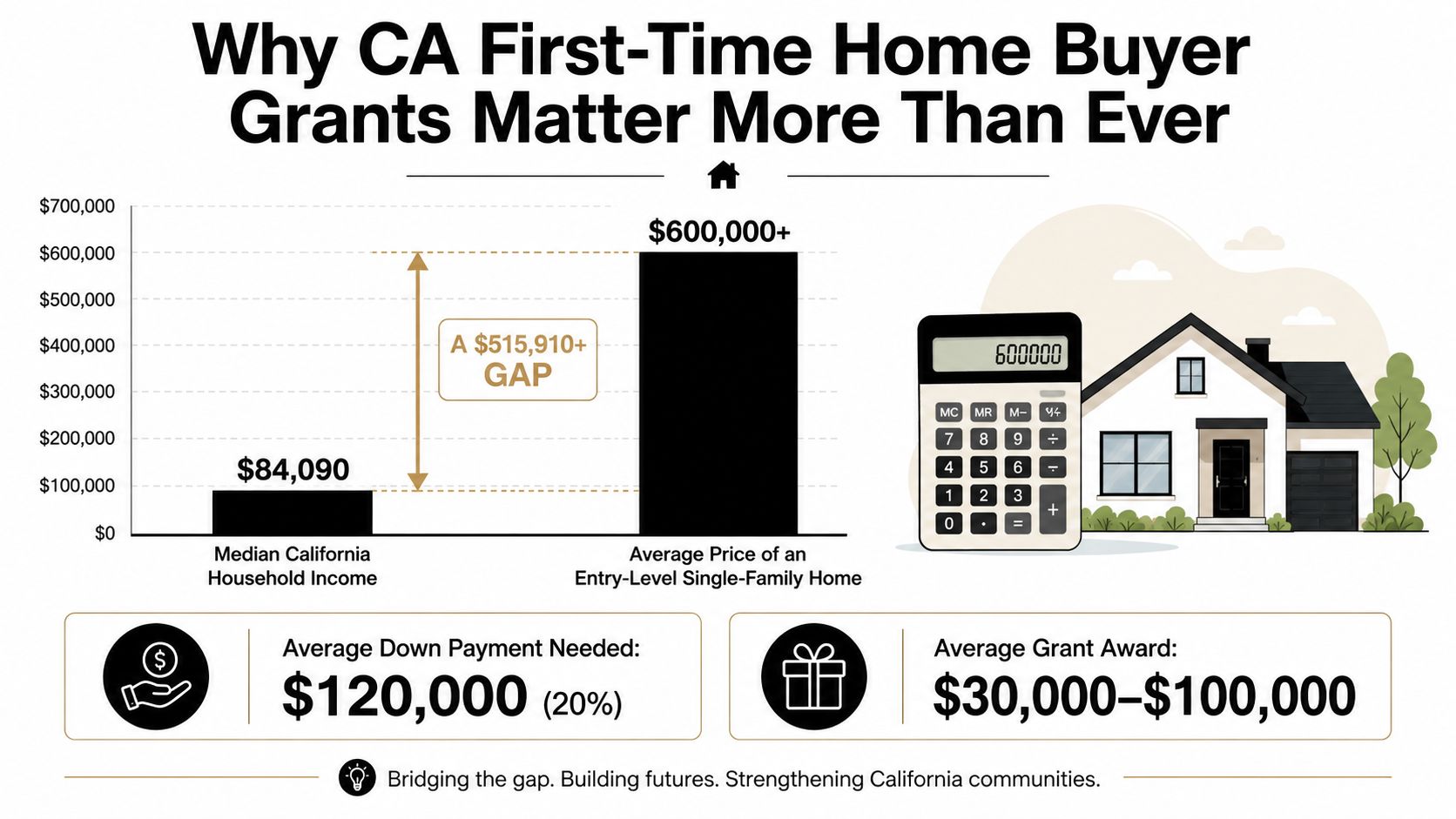
What matters most now is not whether help exists. California has layers of help, but buyers need a map, not a slogan. The state, counties, and cities all use different rules, and the toughest part is figuring out which combinations survive lender underwriting. If you treat every program like free money, you'll waste time. If you treat them like financing tools with trade-offs, you can move much faster.
The real barrier is navigation
A lot of first-time buyers start by chasing the biggest advertised number. That's the wrong instinct. A large program with a narrow target group can be far harder to access than a smaller program with rolling intake and cleaner underwriting.
Practical rule: Choose the program that gets you to approval, not the one that sounds biggest in a headline.
That's especially true for HERO buyers, veterans, first responders, teachers, nurses, and public employees. They often qualify for layered assistance, but the winning move is usually combining a realistic state or local program with employer-aligned support instead of waiting for one giant statewide pool to reopen. The rest of this guide is built around that reality.
What "First-Time" and "Grant" Actually Mean in California
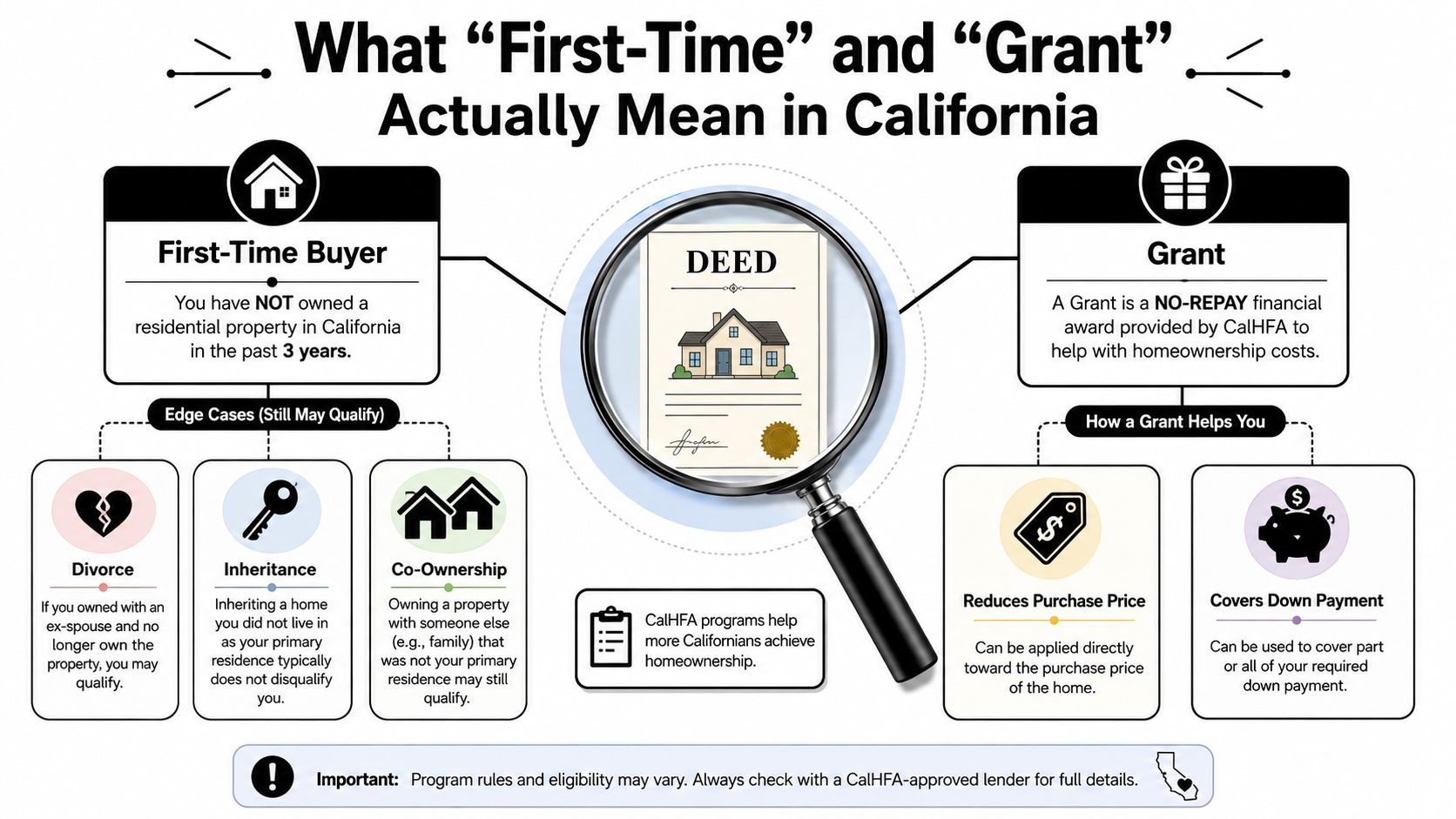
The phrase first-time homebuyer sounds simple until you're inside the file. CalHFA defines it as someone who has not owned and occupied a home in the last three years (CalHFA borrower requirements). That rule matters more than most buyers realize, because ownership history, not just current living situation, controls eligibility. A divorce settlement, inherited property, or a home you owned in another state can all change the analysis, so buyers need to document the last three years carefully before they apply.
Why “grant” often isn't a grant
In California, the word grant gets used loosely. Many programs that people call grants are deferred junior liens, silent second mortgages, or shared-appreciation loans. That legal structure changes what happens later, especially at sale or refinance. A buyer might receive help upfront, but the program can still be attached to the home for years.
A simple example makes this clear. If a program gives a buyer $40,000 as assistance, that can still behave like a lien that's repaid when the home sells or the loan is refinanced, depending on the program structure. The buyer's benefit is real, but it isn't the same as cash in hand with no strings attached.
The state HOME program guideline is the cleanest example of how this works. It uses a 30-plus-year deferred-payment “silent” junior lien, requires the buyer to contribute at least 1% down, and sizes the subsidy so total housing costs land at about 25% to 30% of gross monthly income (California HOME program guideline). That's not a giveaway. It's gap financing, designed to make the first mortgage easier to approve.
If you understand that before you apply, you make better choices. If you don't, you may choose a bigger-sounding program that creates more repayment friction later than you expected.
State-Level CalHFA Programs Worth Applying For
CalHFA is the backbone of California's state-level first-time buyer help, and it's not a tiny side program. In fiscal year 2024-25, CalHFA said it helped more than 6,800 California families buy their first home and financed more than $3 billion in first mortgage loans, surpassing its annual goal by 20% (CalHFA press release). CalHFA also reported that its Single Family Lending Division has invested more than $43.5 billion to help more than 233,000 families buy their first home, which tells you this is a major pipeline, not a one-off boost.
What to look at first
MyHome is the cleanest starting point for a lot of buyers. CalHFA's MyHome program is a deferred-payment junior loan tied to first-time buyer status, and buyers must complete homebuyer education counseling and get a certificate before closing (CalHFA borrower requirements). It's the kind of program that helps with the upfront gap without trying to rewrite the whole deal.
Dream For All Shared Appreciation Loan is different. It's aimed at first-generation buyers, and its demand has been intense enough that CalHFA's $300 million pool was fully committed in 11 days (ABC7 reference page). Governor Newsom's office later said the program had already helped nearly 4,000 first-time homebuyers through its first round of financing, then conditionally approved 1,700 first-generation buyers for a second round. If you qualify, it's valuable. If you're counting on easy access, you're probably going to be disappointed.
CalHome serves low- and very low-income households through local public agencies and nonprofits (CalHome program page). That makes it more targeted and often less visible to casual shoppers, but that targeting is exactly why some buyers should pursue it.
C.A.R. Pathway to Home is another option to watch, especially for buyers from underserved communities. The California Association of Realtors increased closing-cost assistance to up to $10,000 in 2025, which is useful when the problem is not just the down payment but getting to the table with enough cash to close (Pathway to Home update).
| Program | Maximum Assistance | Eligible Borrowers | Structure |
|---|---|---|---|
| MyHome | Varies by loan structure | First-time homebuyers | Deferred junior lien |
| Dream For All Shared Appreciation Loan | Varies by round | First-generation buyers | Shared-appreciation assistance |
| CalHome | Varies by local program | Low- and very low-income households | Local agency and nonprofit delivery |
| Pathway to Home | Up to $10,000 | First-time buyers from underserved communities | Closing-cost assistance |
For buyers who want a straight comparison of layered help, this guide from California Loans for Heroes is a useful companion because it focuses on how state aid fits into a real mortgage file, not just a brochure.
My view is simple. If you're eligible for MyHome, start there. If you're Dream For All eligible, move fast and expect competition. If you're income-targeted through CalHome, let the local agency structure guide you. If you're underserved and short on closing cash, Pathway to Home can be the practical win.
County and City Programs That Stack With State Aid
The biggest dollar amounts often sit at the local level, not the state level. Buyers who stop at CalHFA leave money on the table. Local programs can add meaningful help, but they also bring property-location rules, household limits, and underwriting quirks that buyers need to respect.
Local aid that changes the deal
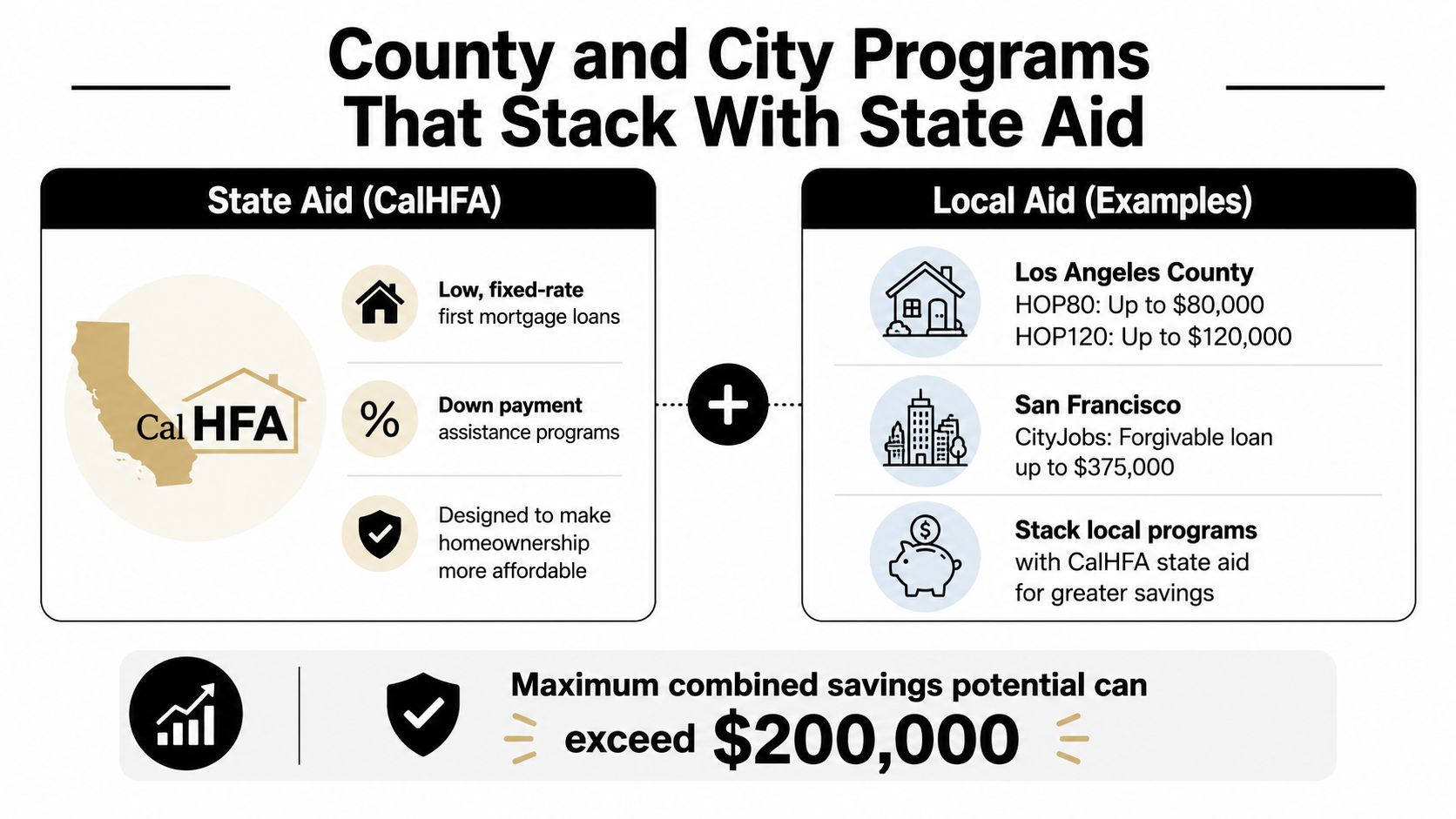
Los Angeles County's Home Ownership Program is a strong example. The Los Angeles County Development Authority says HOP80 and HOP120 offer up to $100,000 or 20% of the purchase price, whichever is less, and applicants must be income eligible, must not have owned a home in the last three years, must occupy the home as their principal residence, and must complete an eight-hour homebuyer education seminar from an approved HUD counseling agency (LACDA Home Ownership Program). That is real assistance, and the rules are just as real.
Local programs can also sit on top of state help. In practice, a buyer often uses a CalHFA first mortgage or first-lien structure, then layers county or city assistance as a second lien or deferred layer. The question is not only whether the program allows stacking, it is whether the full payment and lien structure still pass lender underwriting. That is where files get delayed or denied.
San Diego and other metros use their own structures, often a deferred loan plus a closing-cost grant. The mechanics vary by city and county, but the pattern stays the same. One layer handles purchase assistance, another layer handles closing costs, and the lender decides whether the full stack is supportable.
Loan officers care about payment math first. If the layered assistance lowers the borrower's monthly burden enough to qualify, the file can move. If it creates a lien structure that the lender cannot fit into secondary-market rules, the deal stalls even when the program looks fine on paper.
If you are comparing stacked options, do not just ask how much aid exists. Ask which layer is grant-like, which layer is deferred, which layer is location-specific, and whether the lender will accept the full package. For HERO buyers, California Loans for Heroes is worth a look because the right homebuyer solution has to work inside the actual underwriting file, not just on a marketing page.
Your Step-by-Step Application Checklist
The application process is boring until it isn't. Every delay shows up at the worst possible time, usually after a buyer has already found a home and wants to move fast. The cleanest files start with documentation, not house hunting.
Start with the paperwork that lenders actually verify
Pull your credit reports, gather your income records, and identify anything unusual before you apply. For HERO buyers, that often means extra documentation that standard first-time buyer guides skip, like military leave statements, teacher contract verification, or healthcare shift differential records. Those items can change qualifying income, so they need to be ready early.
Next comes homebuyer education. County programs like LACDA's HOP require an eight-hour seminar from an approved HUD counseling agency, and CalHFA requires counseling and a completion certificate before closing for programs that use its first-time buyer rules (LACDA HOP, CalHFA borrower requirements). Don't leave that until the last minute. The certificate is a gatekeeper, not a formality.
Then get pre-approved through a participating lender. That's where the file gets stress-tested. The lender checks whether the assistance program, the property, and the borrower all fit together. After that, you narrow the home search to properties inside the program's geographic limits and submit the program-specific application with the required certificates and supporting docs.
A realistic timeline from pre-approval to funding is usually 45 to 90 days, depending on how fast the lender, counselor, and program administrator move. If your income file is clean, you'll move faster. If you're trying to document variable pay, military status, or a job change, expect more back-and-forth.
My advice: Get the education certificate before you start touring homes in earnest. It removes one of the most common closing delays.
For buyers who want a tighter checklist, this process guide from California Loans for Heroes matches how these files are handled in practice, which is what matters when the escrow clock starts ticking.
HERO Pathways for Veterans, Teachers, and First Responders
HERO buyers shouldn't shop like everyone else. Their income documentation can be more complex, their public-service status can open different loan layers, and their best option is often a program stack rather than a single headline grant. That's where targeted support matters.
A veteran using a CalHFA-compatible first mortgage might pair it with local assistance, then use employer-aligned buyer support to reduce fees or improve pricing. An active-duty borrower often has stronger income stability on paper than a buyer assumes, but the file still needs military documentation to confirm what counts. That's why prep matters before rate shopping.
A teacher in California usually needs the cleanest possible employment verification. School district pay can be straightforward, but contract timing, extra duty pay, and stipend income can slow underwriting if they're not documented neatly. A firefighter or law enforcement buyer can face a different problem, especially if overtime is inconsistent. The program may approve the borrower, but the lender still has to decide how much income counts.
Healthcare buyers have their own version of that issue. Nurses and hospital staff often have shift differentials, agency hours, or variable schedules, and those details can help or hurt depending on how the lender reads them. California government employees and pilots may have steadier base pay, but they still benefit from layered assistance when the down payment is the primary bottleneck.
California Loans for Heroes' HERO Home Loan and Buyer Rewards Program is built around those kinds of files, offering homebuyer assistance, down payment options, competitive mortgage rates, refinance solutions, lender credits, and one-on-one support for veterans, active-duty military, first responders, law enforcement, firefighters, nurses, healthcare professionals, teachers, educators, pilots, and public employees. For a buyer trying to combine state aid with a practical loan structure, that kind of targeted support can be the difference between a file that closes and one that dies in underwriting.
Choosing the Right Program When You Qualify for Several
Bigger assistance is not automatically better. In California, the largest pools are often the hardest to reach, and the cleanest path to closing is usually the one with the simplest rules and the least competition. Dream For All showed that clearly when the pool was fully committed in 11 days. A big headline number does nothing if the funding disappears before your file is ready.
Use the right decision matrix
First, compare grant size versus access probability. If one program offers more money but comes with tight restrictions, and another is smaller but takes applications on a rolling basis, the smaller one can be the better fit for a live purchase timeline. Second, compare deferred lien versus shared appreciation. Deferred liens are easier for many buyers to understand, while shared-appreciation structures can cost more later if the home appreciates. Third, compare county-restricted versus statewide. A local program can be more generous, but only if the home sits in the right zip code.
A smaller, well-funded program you can close on beats a larger program you keep missing by a week.
I also look at whether the program is first-come-first-served or tied to a lottery or conditional approval round. Buyers chasing a lottery should treat it as an opportunity, not a plan. Buyers who need certainty should prioritize programs with steady intake, clear underwriting, and lenders who already know the file format.
If I were advising a buyer who qualifies for several options, I'd rank them this way. First, the program that fits the lender most cleanly. Second, the one with the highest approval probability. Third, the one with the best long-term repayment terms. That order gets deals closed in California.
Common Questions From California First-Time Buyers
Can state and local programs be combined? Yes, often they can, but the lender has to approve the full structure and the property has to fit every program's rules. The paperwork matters more than the brochure.
What happens to deferred liens at sale or refinance? They usually get paid when the home sells, and some program structures can also trigger repayment on refinance. Read the lien terms before you sign, because “grant” doesn't always mean “no repayment.”
When should you start? Before house hunting in earnest. Get your credit, income docs, and education certificate together first, because that's what keeps your escrow from stalling.
What if you've been denied or your credit is weak? Fix the file before you reapply. Ask the lender which issue broke the approval, then target that problem instead of shopping blindly for another program.
California Loans for Heroes works with buyers who need a loan structure that fits public-service income, first-time buyer rules, and layered assistance. If you're sorting through California grant programs and need help matching the right option to your file, visit California Loans for Heroes and get a straight answer on what you qualify for.