
Most law-enforcement special home loans are just standard conforming, FHA, or VA loans layered with grants or lender credits. FICO, DTI, and reserves decide approval first, and the perk comes second.
You're probably looking at California prices, a 700-ish credit score, and a payroll file that looks fine on paper but still feels tight when you add taxes, insurance, and cash to close. That's a key problem with home loans for law enforcement. The badge can help, but it doesn't erase underwriting, and it definitely doesn't override a weak reserve position.
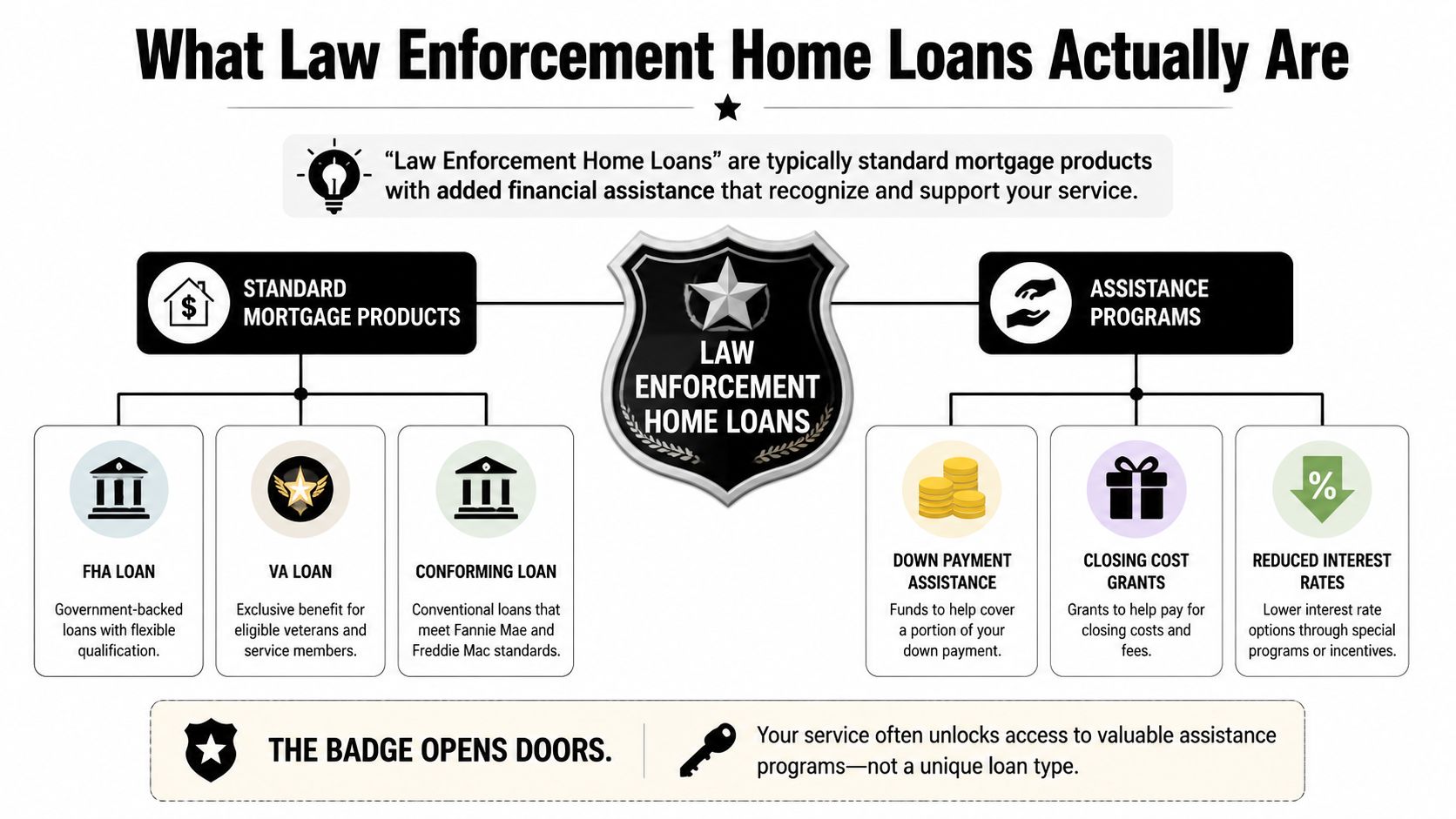
What Law Enforcement Home Loans Actually Are
A lot of officers assume a law-enforcement home loan is its own mortgage type. It usually is not. In practice, the badge is a way to access down payment assistance, closing-cost help, or a rate discount on top of a regular mortgage. The mortgage still has to survive underwriting on its own.
The structure behind the label
Start with the base loan. That is usually conforming, FHA, VA, or USDA, and the officer still has to qualify on income, credit, debt, and reserves. Then the assistance sits on top as a grant, a deferred second lien, a lender credit, or a price reduction tied to a specific property or program. The primary question is not, “Do I qualify for the badge loan?” It is, “Which base loan clears underwriting cleanly, and which assistance stack genuinely lowers my cash to close?”
HUD's Good Neighbor Next Door is the cleanest example of this structure. Eligible police officers can get a 50% discount off the list price of designated HUD homes in revitalization areas, and the required down payment can fall to as little as $100 when FHA financing is used. The catch is simple. The property has to fit the program rules, and the buyer has to live there as a principal residence for 36 months (HUD Good Neighbor Next Door). That is a targeted affordability tool attached to a narrow inventory pool.
State and credit-union products work the same way, just with different mechanics. Some programs are grants, some are forgivable loans, some are second mortgages, and some are rate adjustments. If you want a clean California-oriented overview of how the pieces fit, start with California Loans for Heroes, then compare the program rules against the actual mortgage type you would use.
Practical rule: if the program does not tell you what loan you are getting, what collateral is attached, and what happens if you sell early, it is not a mortgage strategy yet. It is just marketing.
How Layered Assistance Changes the Deal
Layered assistance matters because it changes where the savings show up. Sometimes it lowers the cash you need at closing. Sometimes it shrinks the amount you have to bring from savings. Sometimes it does both, but it does not always change the monthly payment.
For a closer look at how much help these programs can cover, see How Much Does Down-Payment Assistance Cover?
Where the money lands
A standard loan can be paired with a grant, a deferred second lien, or a lender credit. A grant reduces what you need to bring in cash. A deferred second lien usually sits there until you sell or refinance. A lender credit offsets closing costs, which helps when your DTI is fine but your liquid cash is thin. That is the whole game, and it is why people get burned when they focus only on the headline benefit.
For a simple California example, look at the base loan first. A borrower with a stable job and acceptable credit might use a 3% down conventional loan, a 3.5% down FHA loan, or a 0% down VA loan if eligible. The assistance layer then decides whether the deal clears on closing day, not just whether the monthly payment looks fine on a calculator. If the program attaches a deferred second lien or occupancy condition, the savings are real, but they are not free.
Read the closing statement line by line. Ask where each dollar came from. Did the program cut the down payment? Did it pay lender fees? Did it replace cash you would have needed for closing? That answer matters more than the advertised perk. A borrower can feel “approved” and still fail at the table if the cash stack is incomplete.
Base loan first, assistance second. If the base loan does not fit the property, the extra help will not fix it. That is why I would rather see a strong FHA or conventional file with modest aid than a fragile file chasing a flashy benefit.
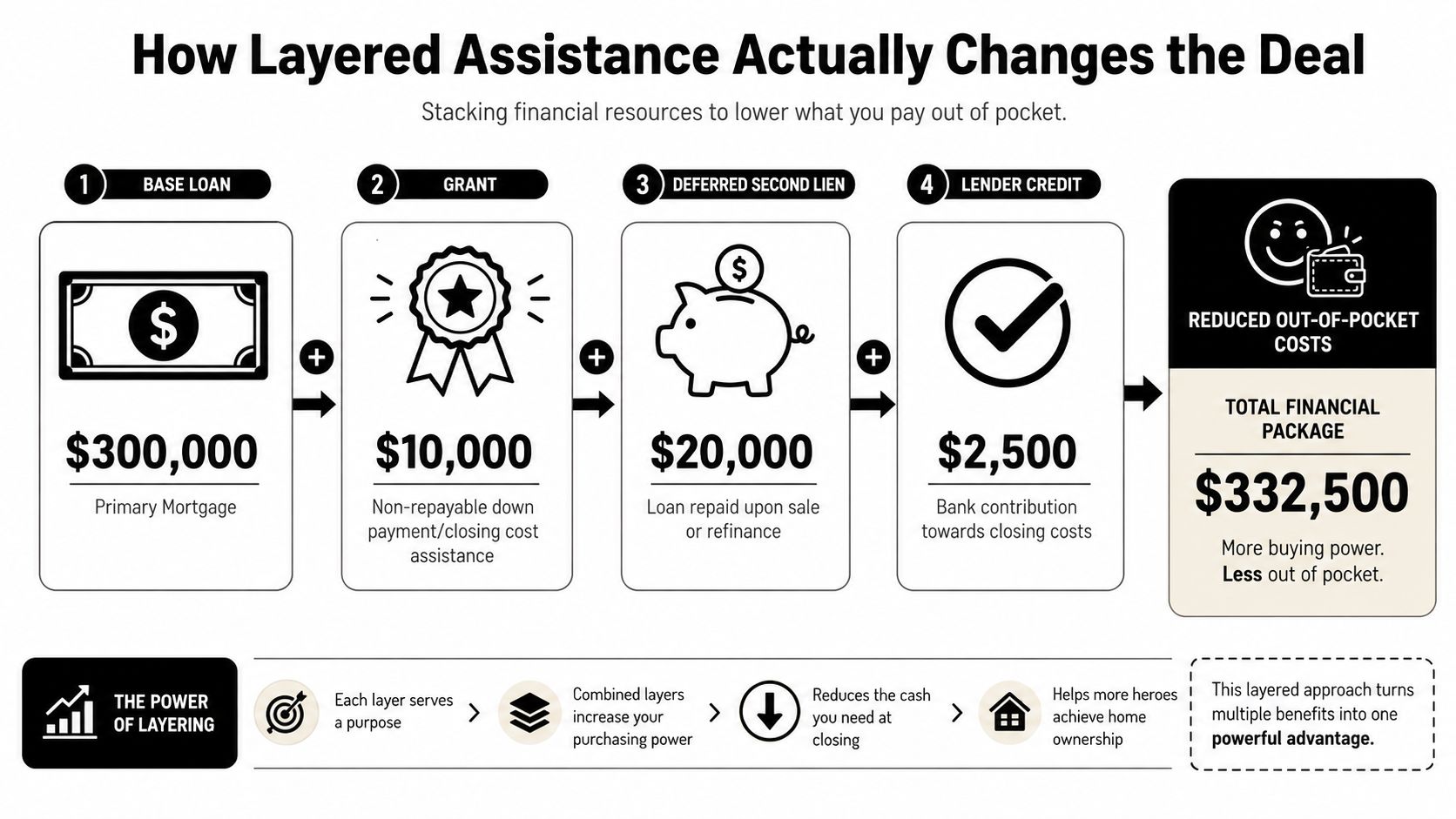
Bottom line: if the assistance only looks good on paper but does not reduce your cash to close, it is not the deal you think it is.
Comparing the Major Law Enforcement Programs
Officers usually see the same three paths: federal discounts, state or city assistance, and private credit-union products. Each one can help, but they help in different ways, and the main question is which one clears underwriting without creating a new problem at the closing table.
| Program Type | Typical Benefit | Key Eligibility Rule | Main Tradeoff |
|---|---|---|---|
| Federal HUD program | 50% price discount on designated homes | Must live in the home as a principal residence for 36 months | Very limited inventory and strict occupancy compliance |
| State grant or assistance program | Cash assistance or forgivable support tied to purchase | Often limited by occupation, home price, income, or location | Savings depend on the state's program design and funding |
| Credit-union HERO product | Rate help, combined financing, or rebate-style support | Usually tied to membership, occupation, and occupancy rules | Often narrower than a plain FHA or VA loan |
| Forgivable city program | Fixed-dollar aid that disappears over time if you stay put | Occupancy requirement over a long period | Good for long-term owners, less flexible if you may move |
| Private lender niche offer | Zero-down or limited-down structure with underwriting overlays | Credit, reserves, DTI, and prior homeownership rules | The headline perk can hide strict approval gates |
HUD's Good Neighbor Next Door is the biggest discount on paper, but it comes with a small pool of eligible homes and a firm owner-occupancy commitment. That makes it a fit for a very specific buyer, not a blanket solution for every officer. Utah's law-enforcement grant data shows how practical aid can still move real volume. Analysts in that report cited 148 grants totaling $2.1 million, an average grant of $14,100, and an average sales price of $398,300, with over $59 million in home sales tied to the program (Utah law-enforcement grant data). The lesson is simple, help works best when it helps a buyer close on a normal house in a normal price band.
Connecticut's police program takes a different approach. It trims an already below-market rate by 0.125%, while also tightening geography and ownership-history rules (CHFA police programs). Chicago's public safety assistance goes in a different direction entirely, with a $30,000, 10-year, no-interest, forgivable loan for a primary residence (Chicago public safety assistance). Those are three different ways to help the same borrower profile, and each one works only if the file fits the program's rules.
California buyers should also look at how a rebate-style structure changes the cash picture. A program like Heroes Home Rebate can matter more than a tiny rate cut when the primary problem is cash to close, not monthly payment. That is the practical comparison officers should make, savings that reduce the amount needed at signing versus a perk that sounds good but leaves the file short on cash.
California Specific Rules Officers Need to Know
California is the state where the sales pitch gets loud and the underwriting stays strict. Officer-specific rules matter more here than in many other states. A program can look generous on paper and still fail the file if the property, credit profile, or occupancy history does not fit.
The California-only product rules
California's Police Credit Union offers a H.E.R.O. Mortgage Loan for active sworn peace officers or reserve peace officers who are first-time homebuyers. The property must be in California, must be owner-occupied, and the borrower must not have owned a principal residence in the prior 3 years. The combined first and second mortgages can go up to $2,000,000, and the application fee is $95 and credited back at closing (H.E.R.O. Mortgage Loan).
That ceiling matters in high-cost counties because it tells you the product was built for expensive markets, not just entry-level homes. The higher cap does not mean the deal gets a pass. The program still sits on top of a normal underwriting file, and that file still has to survive lender review. If you are using the H.E.R.O. Mortgage details above, the core question is whether the rest of the file is clean enough to justify the specialty layer.
The Southern California overlay
Recent reporting on a Southern California law-enforcement zero-down program said borrowers needed a minimum 700 FICO score, three months of reserves, and a maximum 45% debt-to-income ratio, with no homeownership in the prior 24 months and access tied to high-cost conforming-loan limits that can reach $1,249,125 in 2026 (FHFA) (Southern California law-enforcement lending report). That is the part most buyers miss. The special benefit does not help much if reserves are thin or the DTI is already stretched.
Use this filter: if your file barely clears the minimums, a niche California program can slow the deal down instead of helping you close.
The practical takeaway is simple. In California, the occupation rule, the first-time buyer rule, the occupancy rule, and the price-driven underwriting math all have to line up. If they do not, the “hero” label will not rescue the file.
When a Standard Loan Beats a Hero Program
The contrarian answer is often the right one. A plain FHA, VA, or conforming loan can beat a niche law-enforcement program when the specialty option adds reserve rules, geographic limits, income caps, or occupancy strings that shrink your approval odds.

Why broad eligibility wins more often than people admit
Standard loan programs usually give you more room to work with. Conforming loans can start around 3% down for qualified borrowers, FHA around 3.5% down, and VA can allow 0% down for eligible applicants (Direct Mortgage Loans). Those are not hero programs, but they are repeatable and available on more properties. For officers buying in California and needing flexibility, that matters.
Recent market reporting on law-enforcement lending in Southern California also showed how quickly the math gets tight. A zero-down offer still came with a 700 FICO floor, three months of reserves, and a 45% DTI cap (Inman report). If you are close to those boundaries, a conventional or FHA file can close faster than a specialty structure that keeps asking for more documentation.
The broader affordability backdrop matters too. The Federal Reserve's 2024 Survey of Consumer Finances shows the gap between renters and homeowners remains wide, which is exactly why cash-to-close friction still keeps many qualified buyers on the sidelines (Federal Reserve SCF 2024). When reserves are tight, the smarter move is often the loan with fewer approval traps, not the one with the flashiest branding.
Decision rule: run the niche program and the standard loan on the same property, using the same income, reserves, and DTI. If the specialty option adds friction without a clear cash-to-close win, drop it.
Underwriting Hurdles That Decide Approval
The file gets approved or denied in underwriting, not in the brochure. That means the loan file has to stand on its own, with the badge benefit treated as a feature, not a fix. A clean credit score with weak reserves can still fail, and a solid occupation story will not rescue a bad DTI.
The four checks lenders care about
Credit score comes first because it sets the risk picture. In the Southern California program reporting, the floor was a 700 FICO score. Officers sitting near that line need to clean up disputes, balances, and recent late payments before they apply.
Debt-to-income ratio is next. The same reporting pointed to a 45% DTI ceiling. If car payments, student loans, or child support push you close to that line, the program label will not save the file.
Reserves are the quiet killer. That same file required three months of reserves. Officers who can barely cover closing costs often do not make it past this point, because the lender wants proof you will not be wiped out right after funding.
Homeownership history matters more than people think. Some programs require no homeownership in the prior 24 months, while others use a 3-year lookback for first-time-buyer status or occupancy rules. That can shut down repeat buyers who assumed “law enforcement” was enough on its own.
The smart move is simple. Run the specialty program and the standard loan on the same property, using the same income, reserves, and DTI. If the specialty option adds friction without a clear cash-to-close win, drop it.
Don't wait until the loan is in underwriting to learn you are short on reserves. That is the most expensive surprise in the process.
Practical Next Steps for California Officers
Start with a hard pre-application cleanup. Pull your credit, calculate your DTI with the actual housing payment, document your reserves, gather your employment letter, and decide whether the home will be owner-occupied from day one. If you are using a specialty program, get the occupancy timeline in writing before you fall in love with a property.
Questions to ask before you lock anything
- What loan am I getting? Ask whether it is conventional, FHA, VA, or another base structure, because the badge benefit usually sits on top of that.
- What assistance is attached? Confirm whether you are getting a grant, lender credit, deferred second lien, rate adjustment, or forgivable loan.
- What are the deal killers? Get the lender to spell out the credit floor, reserve requirement, DTI ceiling, and occupancy rule before you write an offer.
- What happens if I sell or refinance early? If the program uses a second mortgage or forgiveness clock, you need the exit rules upfront.
- Can this be stacked cleanly? Make sure the assistance does not create a duplicate benefit problem or a closing-cost mismatch.
If you want to compare a California-focused HERO-style structure against a plain FHA or VA route, see California Loans for Heroes above. It offers homebuyer assistance, lender credits, and mortgage options for California public-service borrowers, including law enforcement. I would still run the numbers side by side, because the right loan is the one that closes cleanly, not the one that sounds the nicest.
The rule I give officers is blunt. Pick the loan you can close on, then add the perk if it improves your cash-to-close math. Do not let a flashy program talk you into a file that is harder to fund than a plain FHA or VA loan.
If you are weighing a California HERO loan against FHA or VA and want a straight answer, talk to California Loans for Heroes. They work with California public-service buyers, including law enforcement, and can help you compare assistance options without pretending every specialty program is the right fit.