The most popular advice about down payment assistance for nurses is incomplete. It tells you to find a nurse grant, claim the headline benefit, and assume the affordability problem is solved. In California, that approach can waste time. Nurse-specific assistance can help, but it rarely works as a stand-alone answer in the state's expensive housing markets.
The practical strategy is to combine the right profession-specific benefit with state, county, city, nonprofit, employer, or lender-supported assistance. You also need to understand whether the money is a grant, a forgivable loan, or a deferred second mortgage before you make an offer. The program that advertises the largest amount isn't automatically the program that leaves you with the lowest cash-to-close or the safest refinance options.
Why Nurse-Specific Programs Fall Short in California
A nurse-specific program alone usually won't solve California's affordability problem. The Nurse Next Door program publishes benefits reaching up to $9,000 in grants and up to $24,000 in down payment assistance, with program materials stating that support may be higher in high-cost housing areas, according to its 2026 program information. Those figures sound substantial until you compare them with the cash required to buy in many California markets.
The headline amount also combines different forms of assistance. A grant may cover eligible closing costs or prepaid items, while down payment assistance may sit behind the first mortgage as a second lien. That distinction matters. Money that reduces your initial cash requirement may still create repayment obligations when you sell, refinance, or pay off the mortgage.
The headline amount isn't the affordability test
California buyers need to evaluate two separate problems:
- Cash to close: Can the assistance cover enough of the down payment, closing costs, prepaid expenses, and required reserves?
- Monthly affordability: Will the resulting mortgage payment, taxes, insurance, and other housing costs fit your income?
A large assistance package may solve the first problem without solving the second. In a high-cost area, a smaller down payment can also mean a larger loan balance and a payment that remains uncomfortable. Nurses working overtime or relying on variable shifts should be especially careful. A lender may count qualifying income differently from the way you personally budget your monthly earnings.
The Nurse Next Door materials describe a 3% second-lien loan with no monthly payments and no interest accrual for eligible borrowers, but the structure still needs review before you accept it. Ask when the lien becomes due, whether refinancing triggers repayment, and whether another assistance program can sit behind or ahead of it. You can also compare the program with home loan programs for nurses rather than treating the profession-specific option as your only path.
Practical rule: Treat every advertised maximum as a ceiling, not a personal quote. Your income, property, loan type, county, and program layering rules determine the usable benefit.
Location often matters more than occupation
California doesn't have a state down payment assistance program exclusively for nurses. Nurses generally use the same broad programs available to other buyers, including CalHFA MyHome, GSFA Platinum, and Chenoa Fund, as summarized in this California nurse assistance guide.
That's why a local program can matter more than a nurse label. A city or county benefit may fit your purchase price, income, and first-time-buyer status better than a national healthcare-worker program. Start with the property location, then work backward through compatible assistance. The right question is not, “What does my job qualify me for?” It's, “Which combination reduces my cash requirement without creating an unaffordable payment or an unmanageable lien?”
Understanding Your Down Payment Assistance Options
California nurses typically encounter three assistance categories. Profession-specific programs recognize healthcare employment. Statewide programs focus on first-time-buyer, income, loan, and property rules. Local programs may care little about your occupation and instead prioritize residency, income, property location, or community development goals.
The benefits also behave differently. A grant generally doesn't require repayment when the borrower meets the program conditions. A forgivable loan may become non-repayable only after the borrower satisfies occupancy or retention requirements. A deferred second mortgage usually postpones repayment until a specified event, such as sale, refinance, or payoff.
| Program Type | Typical Benefit Range | First-Time Buyer Required | Repayment Terms |
|---|---|---|---|
| Nurse-specific assistance | Up to $9,000 in grants and up to $24,000 in down payment assistance | Varies by product | Grant terms may be non-repayable; second-lien terms vary |
| Statewide assistance | Varies by program and borrower profile | Varies | Deferred or forgivable structures are common |
| Local city or county assistance | Varies by location and product | Varies | May be deferred, forgivable, or repayable |
| Healthcare-worker or HERO-style assistance | Varies by program and eligibility | Some programs do not require first-time status | May be forgivable or structured as a second mortgage |
The figures in the nurse-specific row come from Nurse Next Door's published benefits. The table is a decision framework, not a promise that every borrower receives the maximum.
Nurse-specific programs
Nurse Next Door describes itself as a nationwide network serving nurses and other healthcare employees in all 50 states, with published benefit tiers that have changed across recent program updates. Earlier coverage cited grants up to $8,000 and down payment assistance up to $10,681, while later materials cite the higher caps. That progression is documented in Nurse.com's overview of the program.
Use these programs as a potential first layer, not as your entire financing plan. Confirm whether the benefit is available for your loan type, whether your employer and license qualify, and whether the program permits another assistance source.
State and local programs
Statewide options can be more useful when a nurse-specific program has restrictive income or property rules. CalHFA MyHome is associated with first-time-buyer eligibility and a deferred second-lien structure. GSFA Platinum is notable because it doesn't require first-time-buyer status, while benefit levels and underwriting rules depend on the product and borrower.
Local programs deserve equal attention. The California down payment assistance resource can help you identify broader options, but your lender must confirm current availability and compatibility. Don't assume that two benefits can be added just because you qualify for each one separately.
Compare assistance against the complete cash requirement
Before you apply, write down the expected down payment, closing costs, prepaid items, and reserves. Then separate assistance into money that is non-repayable, money that may be forgiven later, and money that will eventually become due.
A nurse who qualifies for several programs may have more assistance available than a borrower using one program, but the combined package can also introduce extra inspections, education requirements, lien reviews, and timing constraints. The strongest package is the one that improves both cash-to-close and long-term affordability.
Eligibility Requirements That Actually Matter
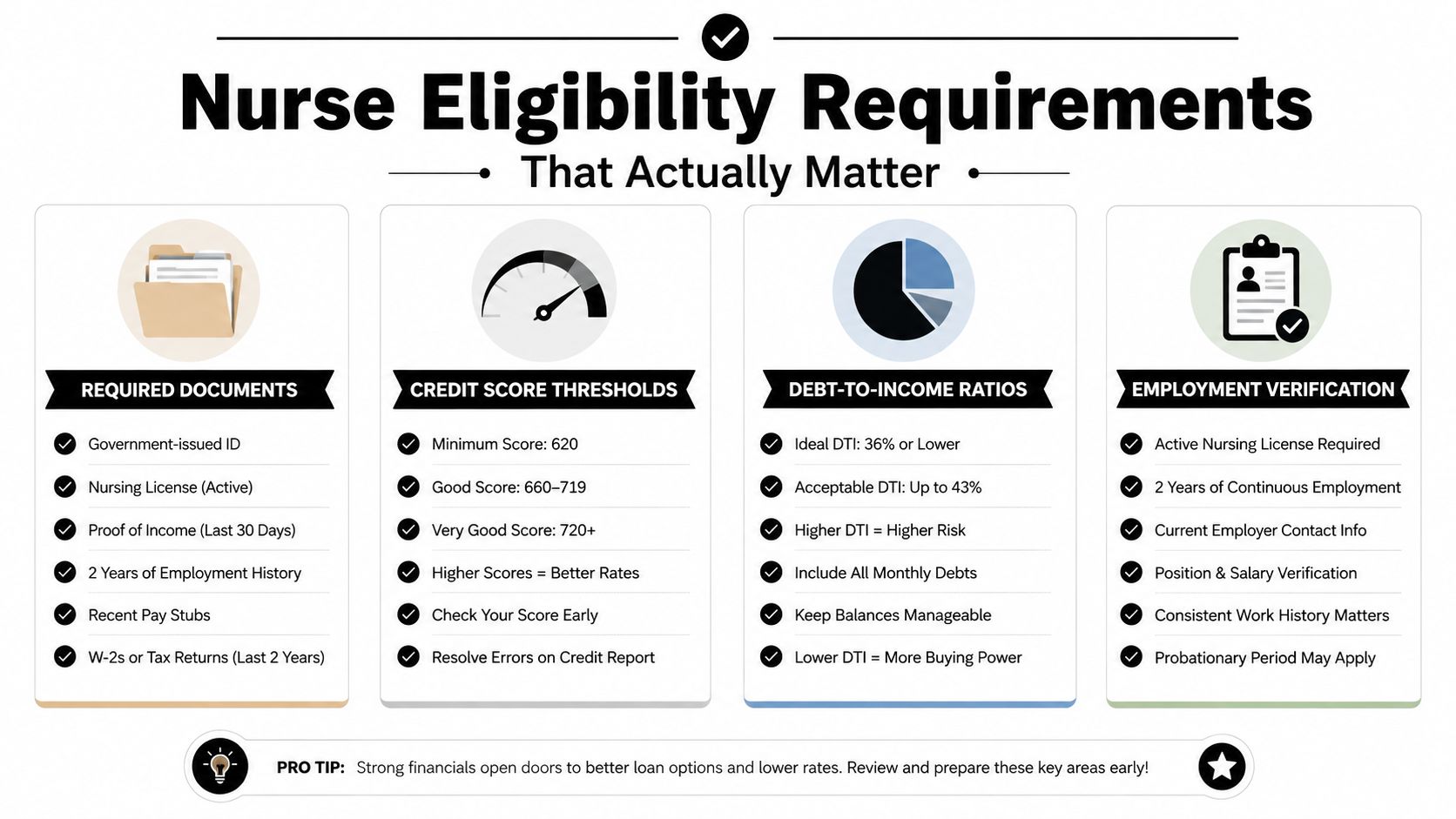
Program websites often lead with occupation and headline benefits. Underwriting decisions usually turn on less exciting details, including household income, county limits, property location, loan structure, occupancy, ownership history, and employment documentation.
A registered nurse with a stable hospital salary may fit one program, while a travel nurse, per-diem nurse, or nurse with several employers may need additional documentation. The issue isn't necessarily the income amount. It's whether the lender and assistance administrator can document the income in a form their rules accept.
Compare the requirements before choosing the program
First-time-buyer status is one of the biggest dividing lines. Some assistance products require you to be a first-time buyer and occupy the property as your primary residence. Others allow non-first-time buyers. A prior homeownership history can matter even if you no longer own the property, so disclose it early rather than hoping it won't appear during underwriting.
Income limits often vary by county and household size. Don't estimate eligibility from your base nursing salary alone. Include qualifying overtime, bonuses, shift differentials, second-job income, and other earnings exactly as the lender will calculate them.
Employment verification can be complicated for nurses who change facilities, work agency assignments, or receive variable pay. Gather a complete employment history, current license information, recent pay documentation, and written explanations for gaps or job changes.
Property restrictions can exclude a home even when the borrower qualifies. Some programs limit eligible properties by location, occupancy, property type, or purchase conditions. Verify the address before you spend money on inspections or negotiate a closing date.
Prepare the evidence lenders actually use
A useful starting file should include:
- Nursing credentials: Your active nursing license and any employer documentation confirming your healthcare role.
- Income records: Recent pay stubs, tax returns when requested, and documentation for overtime, per-diem, or multiple-employer income.
- Asset records: Bank statements showing the source of funds and any transfers into the account.
- Housing history: Current rent or mortgage information and details about previous ownership.
- Identity and household records: Identification, authorization forms, and documents requested for anyone whose income or assets affect eligibility.
Credit score and debt-to-income standards still apply because assistance doesn't replace mortgage underwriting. A program may approve the assistance layer while the first-mortgage lender declines the overall application. Review your debts, avoid unexplained new credit activity, and ask how the proposed second lien will be included in the qualification analysis.
The right eligibility question is not “Do nurses qualify?” It's “Does this program fit my income calculation, ownership history, property, loan, and employment documentation?”
For a broader first-time-buyer review, compare the program rules with California first-time homebuyer assistance. A CalHERO-style option may be relevant for nurses who aren't first-time buyers, because one published description of CalHERO states that it offers a 2% forgivable down payment assistance grant, doesn't require first-time-buyer status, and is open to nurses and other essential workers. Review the current program terms before relying on that structure.
The Application Process and Required Documents
Applying for down payment assistance is closer to applying for a mortgage than applying for a simple consumer benefit. The administrator and lender must verify your identity, income, employment, assets, property, occupancy, and compliance with program rules. A missing document can hold up the entire file because the assistance is usually tied to the first mortgage closing.
Build the file before you shop
Start by identifying programs that fit your target county, likely loan type, income, and ownership history. Then ask the lender for the exact document list. Don't wait until you're under contract to discover that a program requires education, employer verification, or a particular form of income history.
The core file commonly includes:
- Employment verification letters, especially when your work history includes multiple facilities, agency assignments, or variable hours.
- Nursing license copies and proof that your current healthcare position meets the program definition.
- Recent pay stubs and income records for every borrower.
- Tax returns and income explanations when requested for self-employment, contract work, or inconsistent earnings.
- Bank statements showing available funds and the source of deposits.
- Purchase documents, including the executed contract, property details, and occupancy certification.
- Homebuyer education records if the selected program requires a course before closing.
Expect several review stages
The process commonly moves through research, pre-approval, documentation, assistance submission, underwriting, property review, and final funding. The total timeline can span 60 to 90 days in a typical transaction, as described in the application planning guidance for this type of financing. Build flexibility into your purchase contract because assistance administrators and first-mortgage underwriters may review the same file separately.
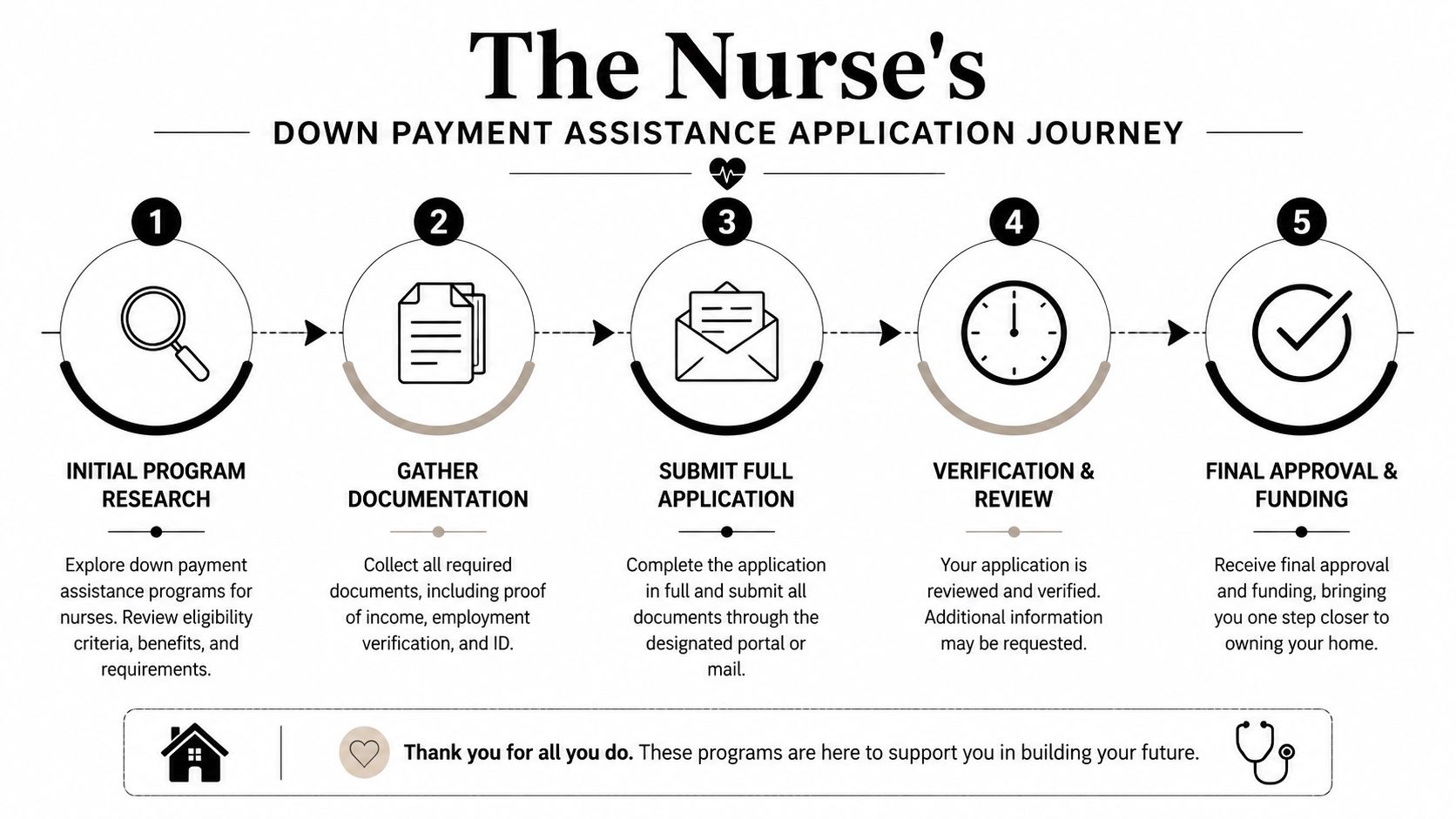
The most common avoidable problems are unexplained bank deposits, mismatched employment dates, outdated pay stubs, undisclosed debts, and opening new credit during underwriting. Changing jobs isn't automatically disqualifying, but failing to explain the change can create delays. Send complete responses in one package whenever possible instead of answering one request at a time.
If a file is flagged for additional review, ask what rule triggered the request and whether the issue affects the assistance, the first mortgage, or both. That distinction helps you solve the problem without abandoning a workable program.
How to Layer Multiple Assistance Programs Successfully
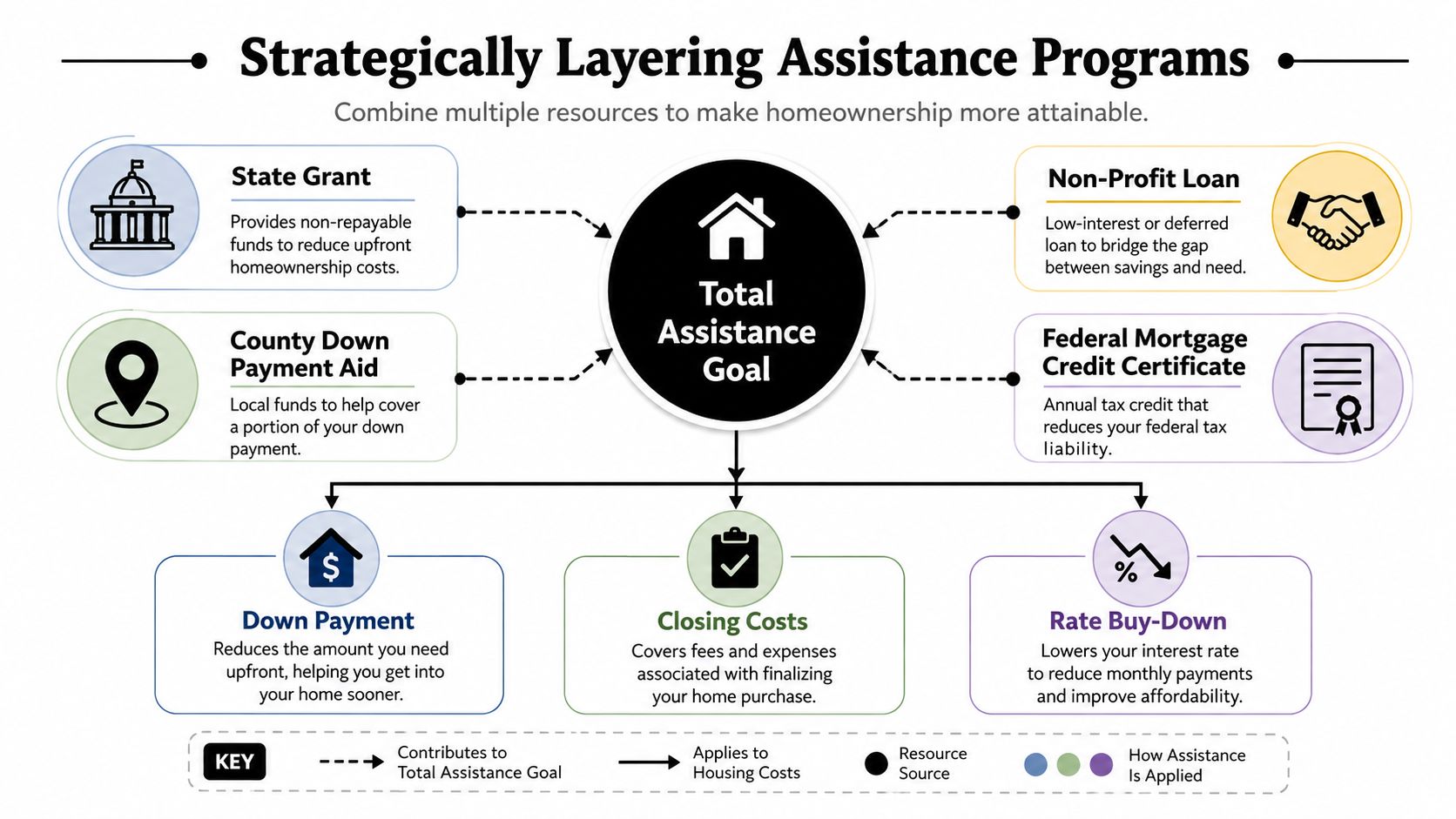
Layering assistance can turn a marginal transaction into a workable one, but only when the liens, grants, and underwriting rules fit together. The existence of thousands of programs doesn't mean they can all be combined. Mortgage Bankers Association reporting cited 2,679 tracked down payment assistance programs in Q1 2026, with 77% active and funded, underscoring both the breadth of the market and the need to match the right local program to your loan structure in the MBA coverage.
Start with the first mortgage
Choose the first mortgage and property before building the assistance stack. FHA, conventional, VA, and USDA financing can carry different rules for subordinate financing, income, reserves, and property eligibility. The assistance administrator must approve the lien position, repayment terms, and required disclosures.
Florida's Hometown Heroes model illustrates why structure matters. It provides up to 5% of the mortgage amount, capped at $35,000, as a zero-interest deferred second mortgage that is repaid when the home is sold, refinanced, or paid off, according to the published program description. California programs won't necessarily use the same terms, so don't transfer assumptions from one state to another.
Map the money by purpose
A practical layering plan assigns each source a job:
- Grant funds can be directed toward eligible closing costs or prepaid items when the program permits.
- Down payment assistance can cover part of the required investment through a grant, forgivable loan, or deferred lien.
- Employer or nonprofit support may fill a remaining cash gap, subject to documentation and lender approval.
- Buyer funds should be reserved for costs the assistance cannot cover, including required reserves or excluded expenses.
A hypothetical package might combine a $9,000 nurse grant, a $15,000 city program, and a $5,000 employer benefit, but those amounts are an example of how to structure a review, not a guaranteed California benefit. Your lender must confirm that every source permits the others and that the total doesn't exceed the actual eligible need.
Confirm repayment before signing
The biggest layering mistakes involve overlooking second-lien repayment, assuming forgivable means immediately free, and failing to compare combined assistance with closing costs. Some programs prohibit subordinate financing, while others require a specific lien order or written approval before another source enters the file.
Ask for a written layering approval before you remove contingencies. Verbal reassurance isn't enough when multiple administrators, a lender, and a title company must coordinate the closing.
Review what happens if you refinance, sell, transfer title, stop occupying the property, or pay off the first mortgage. A package that lowers your upfront cash can still create a future obligation. Choose the stack that supports your expected timeline, not merely the one with the biggest advertised total.
Working with a Lender Who Understands Healthcare Workers
A lender who rarely handles assistance programs may treat your nurse benefit as an afterthought. That creates problems when variable income, multiple employers, shift differentials, or subordinate liens enter the file. You need a lender who can analyze the first mortgage and assistance package together.
Ask these questions during the first consultation:
- Which nurse-specific and general California programs do you currently review?
- Does the assistance count as a grant, forgivable loan, or deferred second mortgage?
- How will the second lien affect qualification, refinance planning, and resale?
- Can the program be layered with state, county, employer, or nonprofit assistance?
- Who verifies my nursing employment and variable income?
- Which fees are lender charges, and which are program or third-party costs?
Get pre-approved before you begin serious home shopping. A proper review should identify your income calculation, estimated cash-to-close, target property restrictions, and likely assistance structure. Compare lenders by the clarity of their written estimates and their ability to explain conditions, not just by the lowest advertised rate.
California Loans for Heroes offers specialized support for nurses and other healthcare professionals, including its HERO Home Loan & Buyer Rewards Program, homebuyer assistance options, down payment assistance review, lender credits, refinance solutions, and one-on-one guidance. It's one lender option to evaluate alongside other qualified California mortgage providers.
California Loans for Heroes can help nurses review specialized home loan options, down payment assistance, and potential program layering throughout California. Visit California Loans for Heroes to request a focused consultation and build a financing plan around your income, target property, and cash-to-close needs.