You're a nurse, you've got a solid job, and you're still staring at California home prices like they're written in another language. That's the core problem with first time home buyer grants for nurses in this state: the grant amount often looks helpful on paper, but it doesn't automatically close the gap on a California purchase. The right move is to stop asking, “What grant can I get?” and start asking, “What combination of grant, down payment assistance, and loan structure gets me to closing?”
Why Nurse Grants Alone Rarely Buy a California Home
A nurse in California can qualify for a legitimate assistance program and still be nowhere near ready to buy on grant money alone. That's because most nurse-targeted programs are built to shave off the front-end cash burden, not replace the mortgage. In practice, the useful number isn't the headline grant, it's whether the full stack covers the deposit, closing costs, and lender requirements without forcing you into a bad loan.
The price problem is why I tell nurses to think in layers. Some programs advertise grants in the $8,000 to $9,000 range, with total assistance sometimes reaching $15,000 to $24,000 or more depending on the structure, but California purchase prices can make that feel small very quickly. A grant that pays closing costs can still be valuable, but it's not a standalone home-buying strategy in Los Angeles, San Diego, or the Bay Area. If you want a clean breakdown of how much help different assistance programs cover, I'd start with this explanation of how down payment assistance is typically sized and applied.
What the numbers mean in real life
If you're a bedside RN with steady W-2 pay, decent savings, and a lender willing to structure the file correctly, a grant can remove friction. If you're relying on it to do the whole job, you'll likely be disappointed. That's the honest line.
Practical rule: use the grant to reduce cash needed at closing, then use the loan program and state or local assistance to cover the rest. That's how California buyers actually get to the finish line.
The smart question is not whether a nurse grant exists. It's whether the grant can be paired with an FHA, conventional, or state assistance program that does the heavy lifting. That stacking approach is what turns a marketing headline into a purchase plan.
Qualifying as a First-Time Buyer and a Nurse
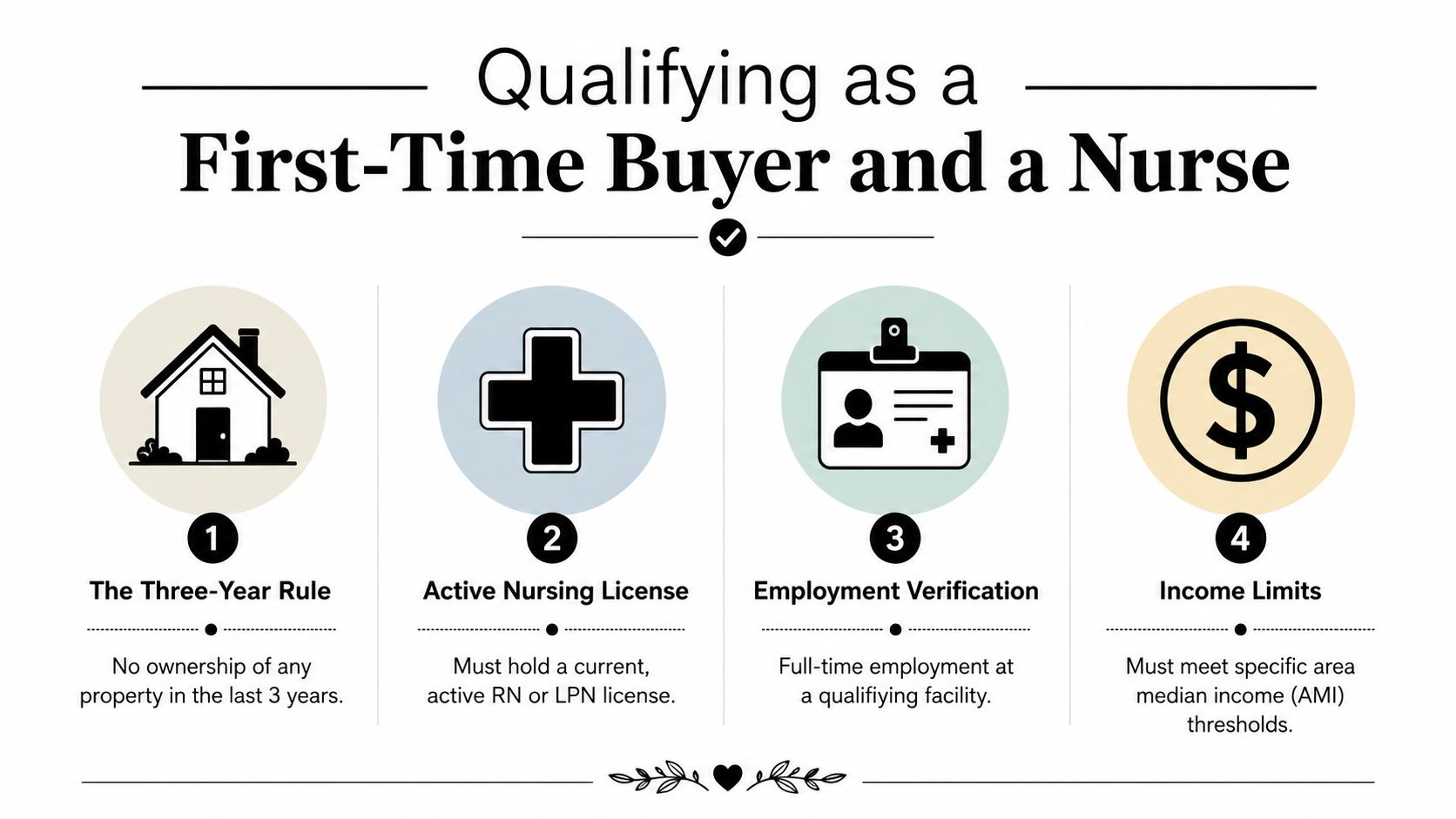
Most nurse homebuyer programs don't start with the grant. They start with whether you're a first-time buyer under the program's rules. A common standard is the three-year no-ownership rule, which means you haven't owned a home in the last three years. Nurse-specific assistance is usually layered on top of that rule, not instead of it.
What underwriters care about
Your job title matters, but your income file matters more. Base salary is usually the cleanest part of the file because it's stable and easy to verify. Overtime, shift differentials, and PRN or per-diem income usually need a documented history before a lender counts them comfortably, and sign-on bonuses are generally treated as assets rather than qualifying income, according to a nurse-homebuyer guide from Own Luxury Homes.
That means the best-prepared nurses aren't just checking eligibility, they're building a paper trail. Keep the last 30 days of pay stubs, the last two years of W-2s and tax returns, and a separate record of variable earnings if you work a mixed schedule. If your pay changes a lot month to month, don't wait until you're under contract to sort it out.
Self-screen before you apply
Run this checklist before you chase any grant:
- First-time status: confirm you haven't owned a home in the last three years.
- License status: make sure your nursing license is current and active.
- Employment type: verify that your work pattern matches the program's rules.
- Income structure: identify what part of your income is base pay, variable pay, or bonus money.
- Documentation: gather two years of tax and income records now, not later.
If you're a travel nurse, PRN nurse, or someone who works a lot of variable shifts, expect more underwriting friction. That doesn't mean no. It means you need a cleaner file than a salaried nurse with steady base pay. The earlier you understand that, the fewer surprises you'll get.
The Four Funding Lanes Nurses Should Know
California nurses usually don't win with one magic program. They win by choosing the right lane, then combining it with the others that fit the deal. The four lanes are state programs, local city or county programs, employer or association programs, and lender-based programs.
Comparison of nurse homebuyer funding lanes in California
| Lane | Typical Provider | Assistance Range | Repayable? | Best For |
|---|---|---|---|---|
| State programs | CalHFA, CalVet, state housing agencies | Varies by program | Sometimes deferred, sometimes forgivable, sometimes no | First-time buyers who need structured, standardized help |
| Local programs | City, county, and local housing departments | Varies by jurisdiction | Often deferred or restricted-use | Buyers shopping in a specific city or county |
| Employer or association programs | Hospitals, unions, healthcare networks, professional groups | Varies by employer or association | Varies | Nurses with employer ties or membership benefits |
| Lender-based programs | Mortgage companies and HERO-style rewards structures | Varies by lender | Often via credits, reduced rates, or assistance tied to the loan | Buyers who want help integrated into the mortgage process |
The state lane is the most predictable because it tends to have clearer rules and stronger standardization. The local lane can be more generous, but it's also more fragmented and location-specific. Employer and association help can be useful, but it's often under-marketed or buried inside HR documents. Lender-based programs are the easiest to tie into a mortgage file because the assistance is handled during the loan process.
How these lanes interact
Don't treat these as competing products. Treat them as potential layers. A nurse can use one lane for down payment help, another for closing cost relief, and a loan product for the actual mortgage.
If you want a California-specific starting point for that lane-by-lane comparison, I'd review this overview of California first-time home buyer assistance. It helps you see where the state-level options sit before you start chasing smaller local pieces.
Straight answer: the best lane is the one that fits your property type, loan type, and income file without creating a repayment trap later.
One more practical point, California Loans for Heroes offers a HERO Home Loan and Buyer Rewards structure that includes homebuyer assistance options, down payment assistance, lender credits, and support for eligible nurses and other public-service workers. That matters because the right lender can make stacking much easier than piecing the file together yourself.
Stacking a Nurse Grant on Top of an FHA or Conventional Loan
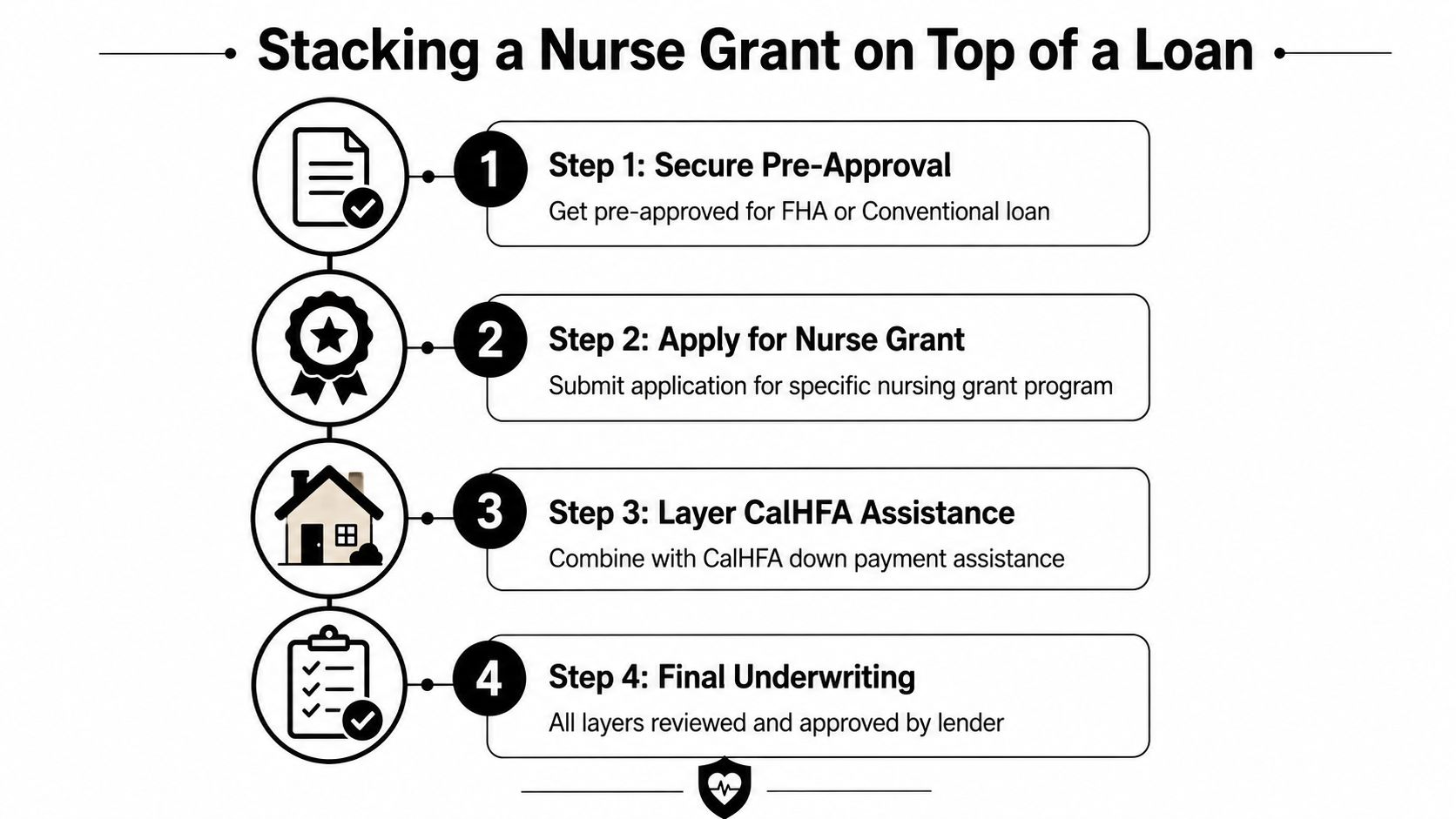
The cleanest way to use first time home buyer grants for nurses in California is to stack them, not depend on them alone. The order matters. Get pre-approved first, then fit the grant to the loan type, then see what state or local assistance can be layered in without breaking program rules.
How the stack usually works
A practical stack starts with a nurse-specific grant covering closing-related costs or prepaid items. State assistance fills the down payment gap. The first mortgage is FHA or conventional, depending on the file. If the lender allows it, lender credits reduce what you need to bring in cash.
This works because these programs usually cover different parts of the transaction. The grant is not replacing the mortgage, and the mortgage is not paying your closing costs. They solve different problems, so the order of operations matters more than the size of any single program.
The most common mistake is trying to make every program fit every loan without checking compatibility first. Some assistance only works with a primary residence. Some assistance fits FHA better than conventional. Some local help cannot be used for every fee on the settlement statement. If you want a conventional-loan example of that layering logic, this explanation of conventional loan structures with down payment assistance is worth reading.
What to do first
Get pre-approved first.
That tells you what loan amount the lender will support and what kind of assistance stack is realistic.Match the grant to the purchase costs.
Use grant funds where they are allowed, usually closing costs, prepaid items, or lender-approved expenses.Add state assistance if the gap remains.
As noted earlier, a grant in that range helps, but it usually does not close the affordability gap by itself in California.Ask the lender to review the full stack early.
Late-stage surprises kill closings.
My rule on expensive California markets: if the assistance only trims your cash-to-close a little, it is not enough by itself. Pair it with a loan and a second layer of help, or it will not move the needle.
The value for California buyers usually shows up in the stack, not the grant alone. A modest nurse grant can help, but it rarely solves affordability in higher-price markets on its own. The right combination turns that assistance into a meaningful bridge.
Timeline, Documents, and Common Approval Traps
Most nurses lose momentum on documentation, not income. The lender wants clean, recent, consistent records, and if your file is messy, the program doesn't matter much. Expect the process to take 60 to 120 days from pre-approval to closing if you're organized and the property cooperates.
What to have ready
Bring these together before you apply:
- Two years of W-2s
- Two years of tax returns
- Thirty days of recent pay stubs
- Employer verification letter
- A separate earnings file for overtime, shift differentials, and PRN income
The last item is the one most nurses forget. If you work mixed shifts or have variable pay, the lender needs a clean record of how that money shows up over time. Without it, you can be qualified on paper and still get delayed in underwriting.
The other trap is tax debt from travel nursing. If you owe taxes from prior years, clean that up early instead of letting it surface mid-file. Lenders see unpaid obligations as a real issue because they affect your ability to close.
A third trap is gift money that sits around too long without clear documentation. If a donor gave you funds for the purchase, keep the paper trail tight. The lender wants to know exactly where the money came from and that it's still eligible for use.
The fix before denial
- Missing PRN history: wait until you've built the required earnings trail or use base pay only.
- Tax issues from travel work: resolve or document them before underwriting.
- Gift funds with weak sourcing: keep donor records and bank statements together from the start.

If you want one simple rule, use this. The stronger your income mix, the less documentation drama you'll face. The more variable your pay, the more patient and paper-heavy the process becomes.
Five Beliefs About Nurse Grants That Are Wrong
Promotional pages make nurse assistance sound like free money with no strings attached. That's not how it works in real transactions.
Myth one, it's all free cash
Some assistance is a grant, but a lot of it is structured as a deferred second lien, a lender credit, or a closing-cost offset. Texas State Affordable Housing Corporation, for example, says its help can be a grant or a deferred forgivable second lien, and Houston's city program says assistance can't be used for realtor commissions, which shows how limited and specific these funds can be. The question is what the money can legally cover, not whether it sounds generous.
Myth two, any grant works with any loan
Wrong. Assistance has to match the mortgage type and the property's primary-residence status. A good lender will check that before you waste time on an application that can't close.
Myth three, you only get one layer of help
Also wrong. In California, stacking is the norm when the file is built properly. One source of help covers one part of the transaction, another source covers another part.
Myth four, all nurses qualify
No. Employment structure, geography, and income all filter eligibility. A full-time salaried nurse is in a much cleaner position than a PRN or heavily variable-income nurse.
Myth five, the grant pays the agent
Not usually, and in some programs it can't be used that way at all. That's why I don't let buyers assume the headline dollar amount equals spendable cash everywhere on the settlement statement.
The smarter mindset is simple. Don't chase the biggest number. Chase the stack that survives underwriting and reaches closing.
Your 30-Day Action Plan and Common Questions
If you want to buy soon, stop browsing random grant pages and start with a 30-day plan. Week one, pull your two years of tax returns, W-2s, and pay stubs. Week two, confirm your first-time buyer status and review how your nursing income is structured. Week three, get lender pre-approval. Week four, compare the assistance stack that fits your loan type and property target.
What to ask before you apply
- Does this program work with FHA, conventional, or both?
- Can the funds be used for closing costs, down payment, or prepaid items?
- Is anything repayable later?
- What income counts, and what income gets excluded?
- Does the program require the home to be your primary residence?
Quick FAQ
Are nurse grants taxable?
Sometimes the tax treatment depends on how the assistance is structured, so don't assume every program is tax-free. Ask the lender or program administrator to explain the form of assistance before you close.
Can I use a nurse grant for a second home or investment property?
No. These programs are designed for owner-occupied primary residences.
What happens if I refinance later?
If the assistance is structured as a deferred second lien or similar program, refinancing can trigger repayment terms. Read the note before you sign, because the repayment trigger matters more than the headline amount.
If you're serious about buying in California, don't keep guessing which nurse grant is real help and which one is just marketing. Start with a lender who understands how to layer assistance properly, compare the programs that fit your income file, and move with a clean plan instead of hoping the numbers work out. Visit California Loans for Heroes to review the homebuyer assistance options available to California nurses and get a structured path to pre-approval.