A California patrol officer can have a dependable department paycheck, strong employment history, and almost no money available for a down payment. Overtime may help the household qualify, but it can also vary from month to month. The question usually isn't, “Is there a mortgage with a badge on it?” It's, “Which loan structure gets me into a home without creating a cash-flow problem or limiting my next move?”
That distinction matters. Many products marketed as law enforcement loans are conventional, FHA, VA, or assistance loans with specialized branding. The useful comparison is not the label. It's the combination of down payment, mortgage insurance, income documentation, eligibility rules, property restrictions, and career flexibility.
The Question Behind Law Enforcement Loans
A California deputy may have stable department employment and still lack comfortable cash reserves after rent, childcare, vehicle costs, student loans, and the expenses that come with shift work. Overtime can improve qualification, but a payment built around variable hours can become a problem after a schedule or assignment changes.
The right decision starts with cash flow and career fit, not the product label. Compare VA, FHA, conventional, and identity-based HERO programs against the amount you can bring to closing, the payment you can sustain, and the likelihood of a transfer, promotion, reassignment, or career change.
Practical rule: Calculate the payment and cash required at closing first. Review the program name only after those numbers work.
Ask these questions before choosing a loan:
- How much cash can you safely use at closing?
- Can the lender document base pay, overtime, differentials, and other income correctly?
- Are you buying a primary residence in California?
- Have you owned a principal residence recently?
- Could a transfer, promotion, reassignment, or career change make a restricted program inconvenient?
A hero-branded mortgage may offer little advantage over a mainstream loan. A genuine assistance structure can help when it lowers upfront cash without adding an expensive or inflexible second lien. The comparison should include the complete monthly payment, mortgage insurance, repayment terms, property rules, and the effect on your ability to move.
Fair-lending enforcement also affects how these applications should be reviewed. In 2023, agencies and the Consumer Financial Protection Bureau reported citing 189 institutions for violations of ECOA and/or Regulation B, while five agencies made 33 referrals to the Department of Justice involving discrimination violations. Those referrals represented a 175% increase from 12 referrals in 2020, according to the CFPB's FY 2023 fair-lending report. Lenders must evaluate an officer's documented eligibility and repayment ability, rather than relying on assumptions about the occupation.
Treat law enforcement loans as a search category, not proof that a specialized product is better. For a California officer, the strongest choice is the structure that protects household cash flow, fits documented income, and leaves room for the next assignment.
What Counts as a Law Enforcement Loan in California
Available mortgage structures address different buyer needs. A product with a hero label is not automatically the strongest option. The useful comparison focuses on down payment, mortgage insurance, income documentation, eligibility rules, property restrictions, and career flexibility.
VA is usually the first option to test for an eligible federal law-enforcement officer with VA entitlement. A qualifying borrower may use a VA mortgage with no down payment and no private mortgage insurance, while also accessing competitive interest rates. The overview of VA loan access for federal law-enforcement officers explains how those features can reduce cash needed at closing and the recurring payment burden.
FHA provides a widely available government-backed structure. FHA financing can go as low as 3.5% down, according to the Police Credit Union H.E.R.O. Mortgage comparison page. It may fit buyers who do not qualify for VA financing or who need more flexible underwriting than a conventional loan provides.
Conventional financing remains the standard comparison point. Conventional loans often require 3% to 5% down, with the exact structure depending on the borrower and transaction. Private mortgage insurance may apply with a limited down payment, so compare the full monthly payment, not just the amount required upfront.
California HERO programs serve a narrower purpose. They may combine a first mortgage with assistance, member benefits, or a fixed second mortgage. Eligibility can depend on occupation, agency, property location, owner occupancy, first-time-buyer status, credit, reserves, and debt-to-income limits. That makes the program details more important than the branding.
| Loan Type | Min Down Payment | PMI Required | Best Fit |
|---|---|---|---|
| VA | 0% for eligible borrowers | No private mortgage insurance | Eligible buyers prioritizing low cash at closing |
| FHA | As low as 3.5% | FHA mortgage insurance applies | Buyers needing a broadly available flexible structure |
| Conventional | Often 3% to 5% | May apply with a low down payment | Borrowers with solid credit and conventional eligibility |
| California HERO program | Program-specific | May be avoided or offset by structure | Qualified first responders who fit the exact restrictions |
A “law enforcement loan” can refer to several different structures. Before applying, identify the actual benefit: lower cash at closing, no mortgage insurance, a better rate, down payment assistance, closing-cost support, or a program tied mainly to occupational marketing. Choose the structure that fits your reserves, transfer risk, and documented household income.
How the Money Works at Closing
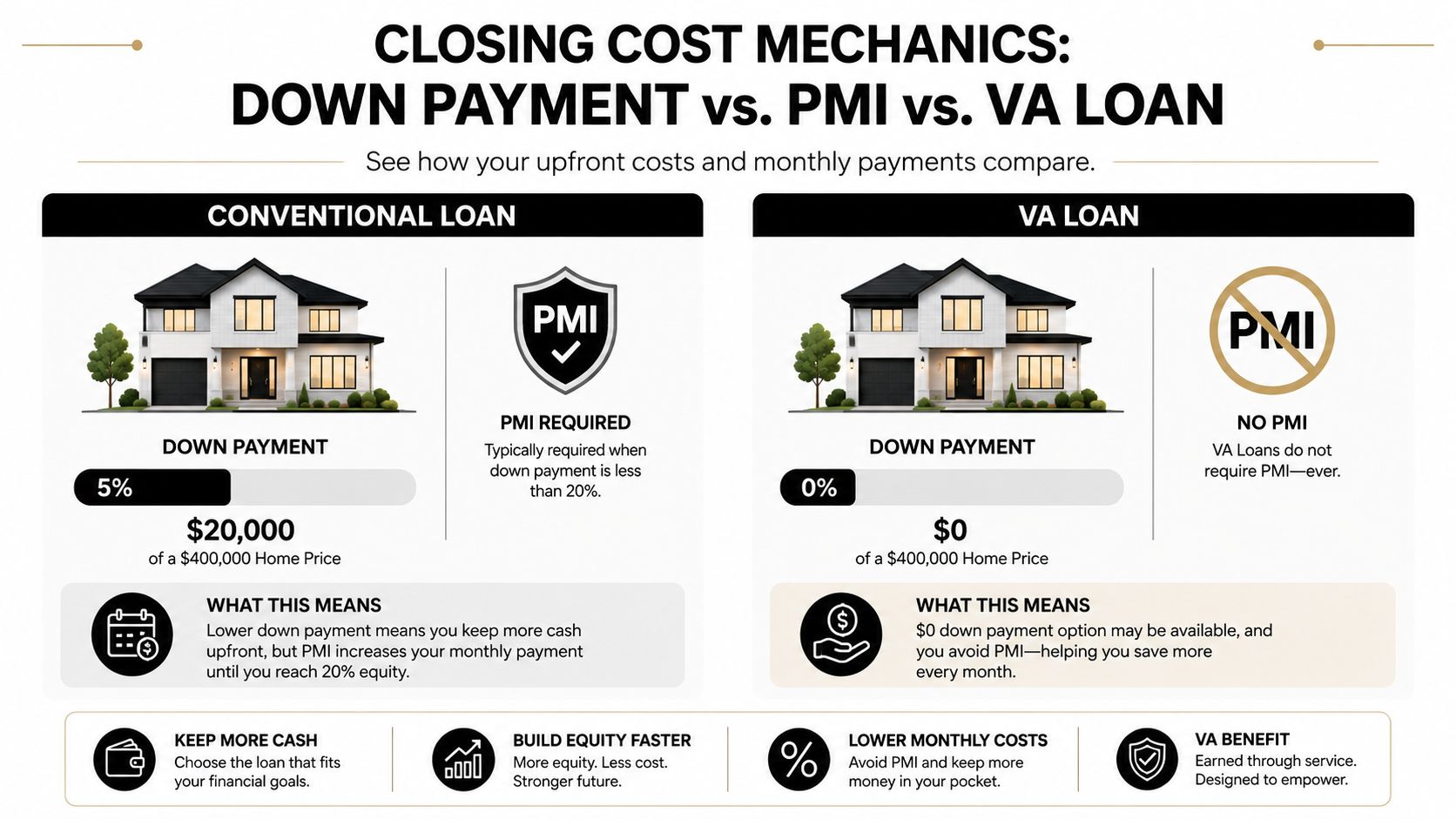
An officer buying a $750,000 California home purchase faces a cash-flow choice before comparing program names. A conventional loan with 5% down requires a $37,500 down payment, before closing costs and prepaid items. A 3% conventional structure requires $22,500, while an FHA structure at 3.5% requires $26,250. These are mathematical illustrations of the stated down-payment levels, not quotes of total cash to close. The applicable conventional and FHA ranges are described in the H.E.R.O. Mortgage program information.
The lower upfront amount preserves savings for repairs, emergencies, or an income disruption. It can also increase the monthly obligation through mortgage insurance. A larger down payment may reduce that cost, but using every available dollar can leave a household exposed. Review reserves and transfer risk alongside the cash needed at closing.
VA changes the starting point for eligible borrowers. A qualifying VA borrower may put 0% down and avoid private mortgage insurance, leaving more cash for reserves and ownership expenses. The monthly payment still depends on the loan amount, interest rate, taxes, insurance, and other transaction terms. “No PMI” does not mean the loan is free or that every VA offer beats every conventional offer.
A second-lien HERO structure needs a complete payment review. One mortgage funds the primary loan, while a fixed second mortgage may cover part of a down payment or assistance need. That can reduce cash required at closing, but the second lien remains debt. Review its rate, payment, repayment terms, and effect on combined loan-to-value with the first mortgage.
Compare the first payment, second-lien payment, mortgage insurance, closing costs, reserves, and refinance restrictions together.
Use this California closing-cost breakdown to review the transaction items. The goal is not merely to preserve cash on day one. Keep enough liquidity for ownership after the keys are delivered.
California HERO Programs Worth Knowing
A California officer choosing among mortgage programs should start with cash flow and career fit, not the program name. The two focused examples are the Police Credit Union H.E.R.O. Mortgage Loan and the LAPFCU Heroes Home Loan. Both can reduce upfront cash needs, but their eligibility rules narrow the buyer pool.
The Police Credit Union program is limited to active full-time sworn peace officers or reserve peace officers employed by a federal, state, county, or municipal agency. The H.E.R.O. Mortgage eligibility rules also require the property to be in California, owner-occupied, and the borrower's primary residence. Eligibility is limited to first-time homebuyers who have not owned a principal residence during the prior 3 years.
That profile fits a qualifying officer purchasing a first California home. It does not fit an officer who already owns a principal residence, wants an investment property, or expects a move outside California. In those cases, compare VA, FHA, or conventional financing instead of forcing an identity-based product to fit.
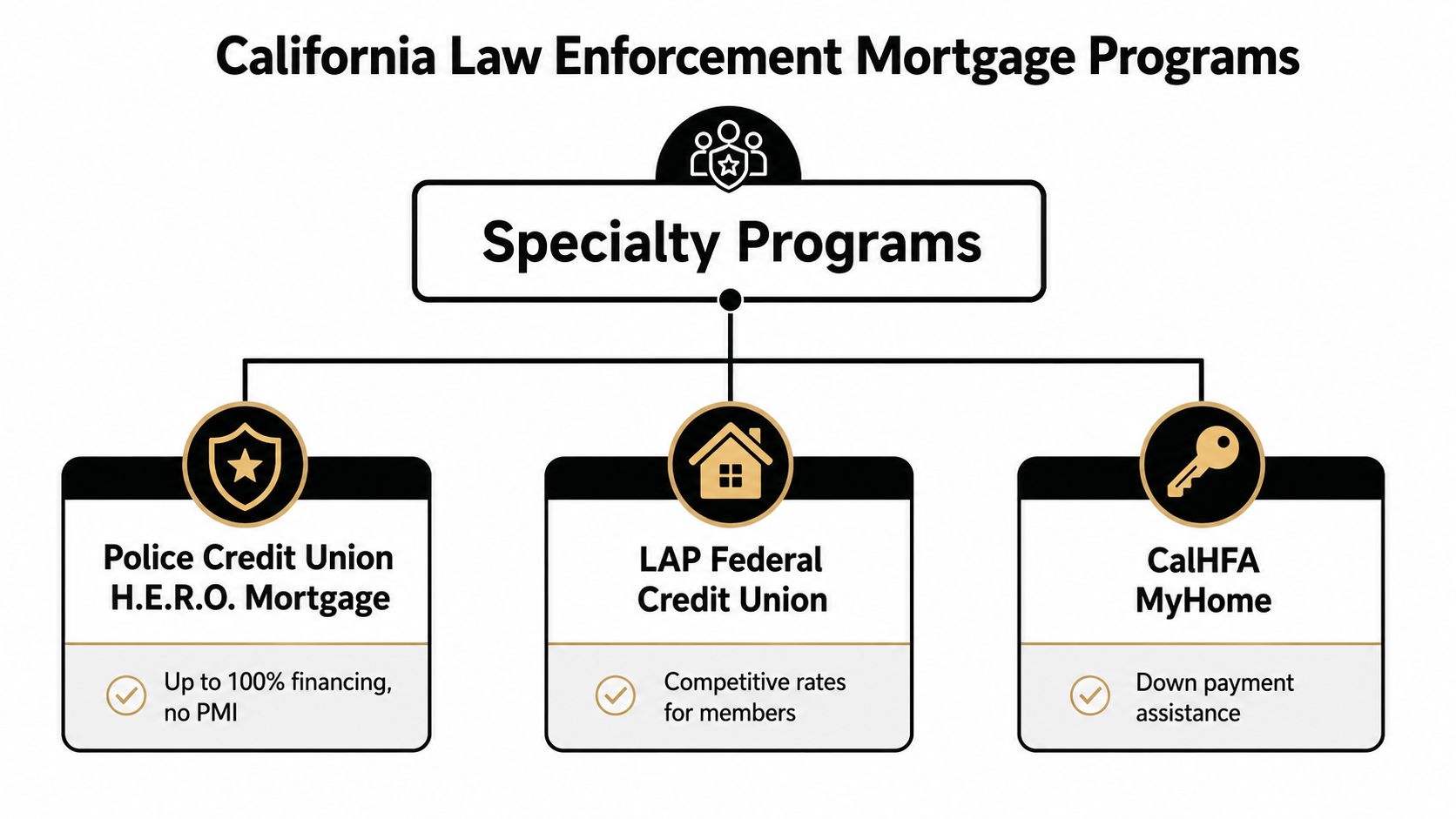
The LAPFCU Heroes Home Loan offers zero-down financing without private mortgage insurance, but the underwriting requirements are substantial. According to the LAPFCU program details, the borrower must not have owned a home during the last 24 months, have at least a 700 FICO score, maintain 3 months of reserves, and stay at or below a 45% debt-to-income ratio. The loan can reach the Fannie Mae/Freddie Mac conforming limit for high-cost areas, which is $1,249,125 for 2026 (FHFA conforming loan limit values).
An eligible occupation alone does not guarantee approval. Credit, reserves, debt, and recent ownership can eliminate the program before the rate or cash-to-close comparison matters.
The market also includes broader first-responder assistance, including programs advertising as little as 1% down. A 2025 homeownership program index lists educators, veterans, and first responders among targeted groups, as reported in the H.E.R.O. Mortgage program material. Treat that language as an initial screening point. Confirm income limits, property rules, repayment terms, and total monthly cost before choosing a program.
Eligibility and Documentation Checklist
A lender can approve an officer only when the file clearly supports the income, credit, debts, reserves, property, and occupancy. Assemble that evidence before comparing rates or assistance terms.
Confirm the borrower profile
Start with the rules that can eliminate a program:
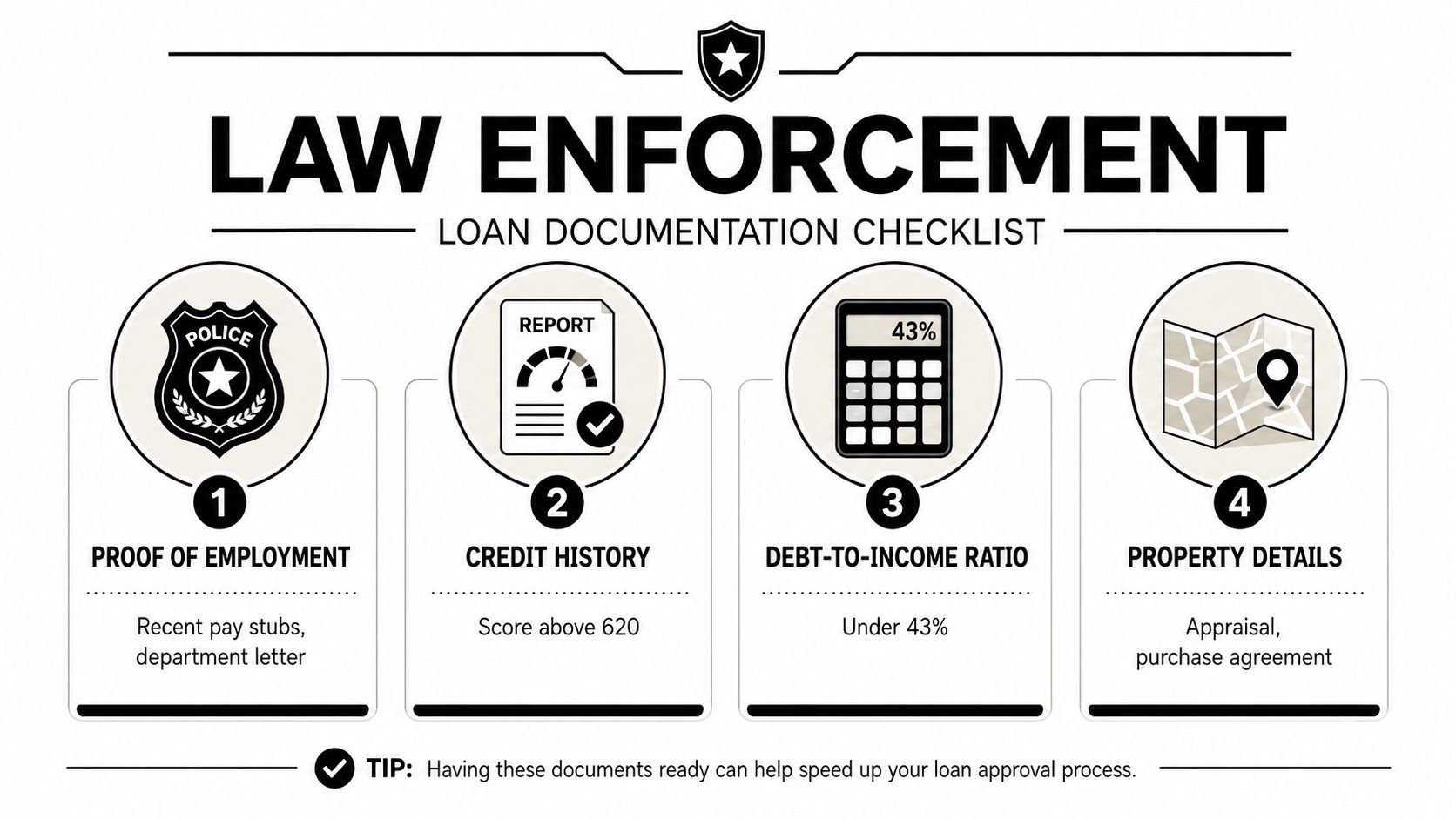
- Employment: Provide recent pay records and department verification. Separate base pay from overtime, shift differentials, hazard pay, and assignment-related compensation so the lender can determine what income is usable.
- Credit: Review the score and payment history before choosing a structure. The LAPFCU example requires a 700 FICO score, while VA, FHA, conventional, and other specialty programs may apply different standards.
- Debt-to-income: List auto loans, student loans, credit cards, support obligations, and every other recurring debt. LAPFCU uses a maximum 45% DTI, so overtime does not automatically solve a high-debt profile.
- Reserves: Document accessible funds remaining after closing. LAPFCU requires 3 months of reserves. Other programs may set different requirements.
- Property and occupancy: Confirm that the home will be your primary residence and that its location satisfies the program rules.
- Ownership history: Check whether previous ownership affects first-time-buyer eligibility.
Your occupation opens a screening path, not an approval shortcut. Compare each option by cash needed, monthly payment, transfer risk, and how the lender treats variable household income.
The SAFE Act governs the lender's compliance responsibilities. Mortgage loan originators must be licensed or registered, and the NCUA's SAFE Act and Regulation G guidance warns that weak third-party oversight can create compliance, transaction, and strategic risk.
Build an audit-ready file
As noted in Section 0, the CFPB cited 189 institutions for fair-lending violations in 2023. The practical takeaway is straightforward: the lender must support the decision with consistent, documented standards, including when an applicant's income or employment has unusual components.
Use this California home-buying checklist for borrowers to organize pay records, employment letters, bank statements, debt statements, requested tax documents, and the purchase contract. Keep digital copies easy to retrieve, and explain deposits, job changes, transfers, or gaps before underwriting raises questions.
When a HERO Program Wins and When It Does Not
Program value depends on eligibility fit and cash-flow impact, not on occupation alone. A first-time California buyer with limited savings, stable department employment, acceptable credit, manageable debt, and a primary-residence purchase may gain meaningful value from zero-down or assistance financing.
The clear win case
A specialty program deserves serious consideration when:
- The property is a California primary residence.
- The buyer meets the first-time ownership requirement.
- The borrower can satisfy credit, reserve, and DTI rules.
- The assistance terms are cheaper or more practical than the alternatives.
- The buyer expects to remain within the program's geographic and occupancy boundaries.
Compare the offer against VA, FHA, and conventional financing before choosing it. VA may provide a better fit for an eligible borrower, while FHA or conventional financing can work better when the assistance creates a costly second lien or restrictive repayment provision. Review the full monthly obligation, cash required at closing, and the effect on future borrowing capacity.
The poor-fit case
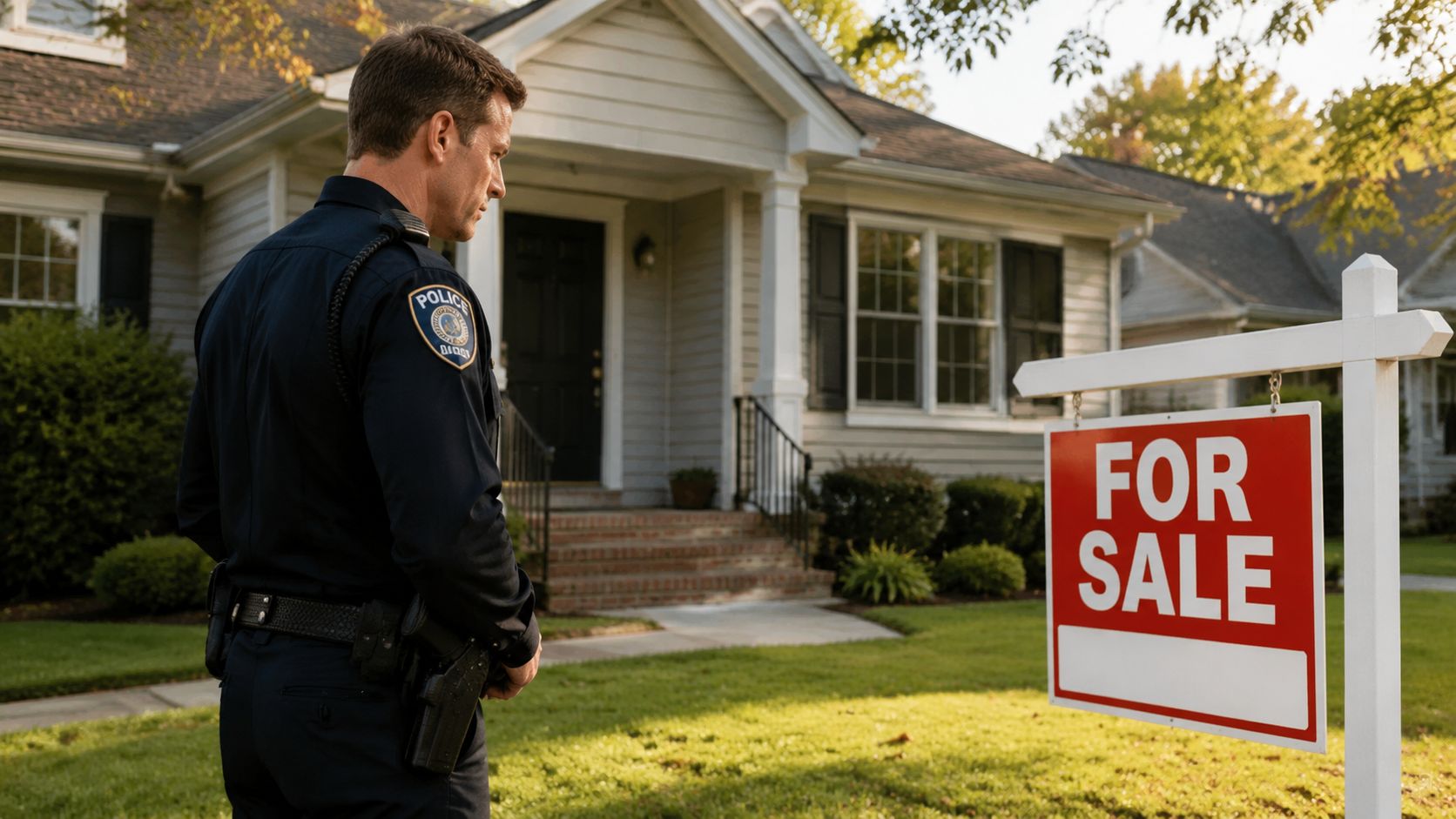
A HERO structure is usually a weak fit for an investment property, a non-owner-occupied home, or a residence outside California. It may also miss the mark for a sergeant upgrading after recent ownership, a federal agent eligible for VA financing, or a household whose approval depends heavily on overtime that may end after a transfer.
Career mobility deserves a place in the decision. Ask whether the payment remains workable after reassignment, whether refinancing is practical, and whether the household qualifies without stretching variable income. A program that lowers the initial cash requirement can still create pressure if the borrower expects to move soon or cannot retain the property's required occupancy status.
The California police and fire mortgage-rate resource helps compare available pricing, but a rate does not answer the portability question. Choose the structure that fits the household's next move, down-payment capacity, and income pattern, rather than the current job title.
Your Application Timeline and How California Loans for Heroes Helps
A clean application follows a sequence. Skipping steps creates avoidable pressure later.
- Pre-approval: Provide employment, income, asset, credit, debt, and ownership-history documents. Ask the lender to review overtime and shift differentials instead of assuming all variable pay will count.
- Program comparison: Price VA, FHA, conventional, and eligible HERO structures side by side. Compare cash to close, recurring payment, mortgage insurance, second-lien terms, reserves, and property restrictions.
- House hunting: Set the search range from the approved payment, not the maximum purchase price. Keep room for taxes, insurance, repairs, and income variability.
- Offer and contract: Make sure the financing type, occupancy, and assistance structure match the offer. A program restriction discovered after acceptance can create a serious timing problem.
- Appraisal and underwriting: Respond quickly to requests for pay records, explanations, bank statements, employment verification, and property documents.
- Final approval and closing: Review the final disclosure, confirm funds needed, and verify that the first mortgage and any second lien match the terms you accepted.
A California HERO specialist can help match the borrower to a structure, coordinate assistance, and organize documentation for overtime, shift differentials, and other compensation. Some loan programs also advertise line-of-duty loan cancellation up to $850,000, as shown in law-enforcement mortgage product information. Treat that feature as a contract term requiring careful review, not as a general benefit available on every law enforcement loan.
Key Takeaways and Common Questions
The decision rule is straightforward: compare mainstream loan structures first, then add a HERO program only when its eligibility and terms improve the fit. VA is the natural starting point for eligible borrowers who value zero down and no private mortgage insurance. FHA offers flexibility, conventional financing remains a standard option, and California HERO programs can help when their restrictions match the buyer.
Is down payment assistance taxable?
Mortgage and assistance tax treatment depends on the program documents and the borrower's circumstances. Ask a qualified tax professional before assuming assistance is taxable, deductible, forgiven, or treated in another way.
What happens if I transfer or leave law enforcement?
The mortgage generally remains governed by its note and program documents, not by your continued job title. A transfer can still affect your income, occupancy, geography, or eligibility for future benefits, so review the rules before accepting a restricted program.
How long does the process take?
The timeline depends on document quality, appraisal scheduling, underwriting conditions, property issues, and the assistance program. Start early, keep the file current, and respond to requests promptly.
Can I use a HERO mortgage for an investment property?
Many officer-targeted programs require an owner-occupied primary residence. Confirm the occupancy rule before making an offer. For an investment property, a conventional investment-property structure may be more appropriate than a specialty first-responder program.
California Loans for Heroes helps California law-enforcement officers and other first responders compare home loans, buyer assistance, down payment options, refinance solutions, and lender credits based on their actual household and career plans. Visit California Loans for Heroes to request a focused comparison before you choose a loan because of its branding alone.